WASHINGTON (AP) — Plummeting stock prices have taken a toll on U.S. consumer confidence, though there are signs the setback may be temporary.
The University of Michigan says its consumer sentiment index fell to 91.9 this month from 93.1 in July. The index is still up 11.4 percent from a year ago.
The figures provide an early read of the impact on consumers from the 1,900 point drop in the Dow Jones industrial average over six days through Tuesday. Stock prices have since recovered some of those losses.
The University of Michigan surveys consumers throughout the month and so some of the responses were tallied as the stock market plunged.
Even so, the survey also found that Americans remain confident about the U.S. economy and their personal finances.
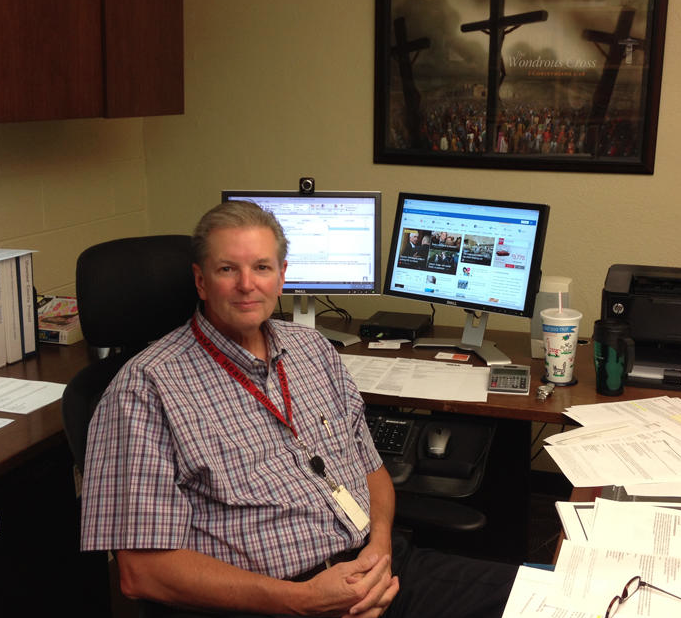
David Sanford, CEO of Wichita-based GraceMed, says health centers that serve Kansans who lack insurance or have trouble paying for health care are seeing growing demand for their services. CREDIT BRYAN THOMPSON / HEARTLAND HEALTH MONITOR
Health centers that serve Kansans who lack insurance or struggle to pay for primary health care are seeing no lack of demand for their services.
Rebecca Lewis was once among those Kansans. In 2011, the McPherson woman found herself working three part-time jobs and trying to complete a college degree. As a single mom with three young boys — then ages 8, 5 and 2 — it was hard to make ends meet.
“My earned income was under $10,000,” she says. “I was experiencing extreme survival mode. Every single day is a fight. So, plugging in everywhere I knew how and running my tail off every day. And it was always about the rent, and the lights, and transportation.”
Although her sons had health coverage through the Kansas Medicaid program, she found it challenging to find a doctor who would accept them as patients. She could have taken them to community health centers in Hutchinson or Salina, but those were 30 miles away. So Lewis did what a lot of people in her situation do.
“There were times that I would wait until later in the evening and take them to the emergency room when I knew that they needed antibiotics, because it was a better short-term choice for me and my children if I didn’t have to miss work or miss school and go out of town,” Lewis says.
Relying on the emergency room for health care is expensive and meant that her boys only saw a doctor when it was absolutely necessary. They missed a lot of the routine preventive care kids are supposed to get.
Lewis and others who couldn’t afford health care wondered why McPherson didn’t have its own clinic to serve uninsured and underinsured patients. Then a local committee studying ways to address poverty came up with a solution: partner with an existing federally funded health center to open a satellite clinic in McPherson.
Wichita-based GraceMed has agreed to do just that. As soon as a location in McPherson can be finalized, the committee plans to conduct a fund drive to raise the money to pay for the building and equipment.
“We will take over, in terms of providing the medical provider and the support staff to deliver that care,” says David Sanford, chief executive officer of GraceMed, a ministry of the United Methodist Church that operates 10 clinics serving 35,000 patients in the Wichita area.
“It’s just a great opportunity to bring clinical services to a community without repeating all of the administrative costs that would go into establishing an independent entity,” he says.
Sanford expects the clinic in McPherson to be sustainable for the long haul. That’s based on the assumption that 60 percent of the patients there will have some form of insurance, whether it’s private coverage, Medicare or Medicaid. Sanford says that target would be easier to meet if Kansas would expand Medicaid eligibility.
“Without Medicaid expansion, the state is making it even more difficult for people to access quality care,” he says. “They’re basically forcing them to get into the bad habit of going to the ER for non-emergency care. They’re forcing people to wait too long to come and be seen by a physician just because they don’t have the resource to do so.”
And people literally are dying because of it, according to Krista Postai, who runs the Community Health Center of Southeast Kansas. The Pittsburg-based organization operates 10 health centers that serve 40,000 patients in four counties in southeast Kansas — an area with some of the state’s least-healthy residents https://www.khi.org/news/article/southeast-kansas-counties-still-rank-low-for-health .
“Down in southeast Kansas, depending on what county you live in, you’re likely to die five or 10 years earlier than other Kansans,” Postai says. “The No. 1 reason for that is access to care, and that’s why every night when I go to bed I pray that Medicaid will expand someday.”
The Community Health Center of Southeast Kansas is among six Kansas health centers that will receive $4 million in federal funding to open new facilities https://bphc.hrsa.gov/programopportunities/fundingopportunities/NAP/0815awards/ks.html . Postai’s organization will use $475,000 to open a new health center in Parsons, replacing an all-volunteer clinic that had been open one afternoon a week.
The health centers are able to provide basic care for uninsured patients, Postai says. However, if uninsured patients need specialty care — like cancer treatment or a heart bypass — they may be out of luck.
“If they had Medicaid, I could refer them in to specialists,” Postai says. “But right now we are finding it almost impossible to find providers who will take patients who have no coverage.”
Currently, 45 percent of the patients at Postai’s clinics have no insurance. She estimates that figure would drop to 10 percent if Kansas expanded Medicaid.
There’s no end in sight to the demand, she says, as patient volume at the clinics has been growing around 18 percent each year.
Bryan Thompson is a reporter for Heartland Health Monitor, a news collaboration focusing on health issues and their impact in Missouri and Kansas.
TOPEKA, Kan. (AP) — Five months after a new law for funding public schools took effect in Kansas, legislators and education officials are talking about drafting another one next year.
The interest comes from critics of this year’s changes in how the state distributes more than $4 billion in aid to 286 school districts — but also from Republican lawmakers who supported the new law.
The new law took effect in early April. It jettisoned the state’s old, per-student formula for distributing aid to the districts, replacing it with grants based on what each district received during the previous school year.
The law set aside money for school funding through June 2017.
The new law’s authors said from the beginning it was a short-term fix for the problems they saw in school funding.
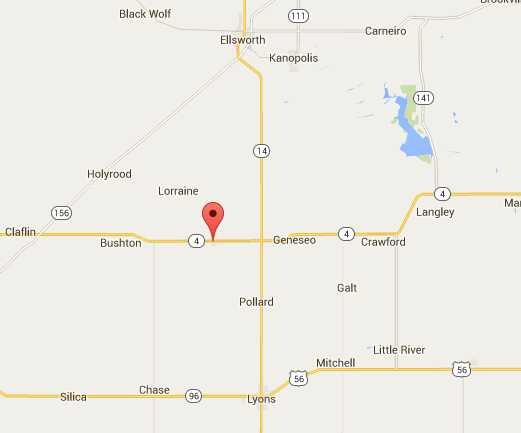
Fredrick is located on Kansas 4 east of Bushton- click to expand- google map
FREDERICK, Kan. (AP) — The future of a tiny central Kansas town is uncertain after no one ran in an election to pick its leaders or apparently even voted.
The Hutchinson News reports that with no mayor or city council, the town of Frederick was unable to submit a budget that was due Tuesday to Rice County officials.
County Clerk Alicia Showalter says no one in the town of about 10 residents has made an attempt to meet about the situation.
More than a dozen states have passive dissolution laws that would take effect when a town fails to elect or appoint officers or levy and collect taxes. Kansas isn’t one of them.
Showalter says it could take legislative action to dissolve the town.
WICHITA, KAN. – A Wichita man who was arrested after putting a gun to his girlfriend’s head pleaded guilty this week to a federal firearm charge, according to U.S. Attorney Barry Grissom.
Teagan C. Gulley, 35, Wichita, Kan., pleaded guilty to one count of unlawful possession of a firearm following a felony conviction. In his plea, he admitted that Wichita police officers responding to a report of domestic violence saw him pointing a gun at his girlfriend. He was arrested and officers seized a .45 caliber handgun. He was a previously convicted felon at the time and he was prohibited by federal law from possessing a firearm.
Sentencing is set for Nov. 9. Both parties have agreed to recommend a sentence of 77 months in federal prison.
BOISE, Idaho (AP) — The U.S. Department of Agriculture has approved a potato genetically engineered to resist the pathogen that caused the Irish potato famine and that still damages crops.
Idaho-based J.R. Simplot Co. says that the Russet Burbank can also be stored at colder temperatures longer to reduce food waste.
The potato is the second generation of Simplot’s Innate potatoes and also includes the first generation’s reduced bruising and a greater reduction in a chemical produced at high temperatures that some studies have shown can cause cancer.
The Food and Drug Administration in March approved the first generation potato as safe for consumers.
Company officials say about 400 acres of those potatoes were marketed as White Russets last summer and sold out in grocery stores in the Midwest and Southeast.
KU’s Prairie Acre (Photo by Chuck France / University Relations)
LAWRENCE, Kan. (AP) — A small piece of native prairie tucked away on the University of Kansas campus will be restored this year.
The Prairie Acre, which is actually only one-third of an acre, has never been tilled, plowed or shoveled. It sits behind Blake Hall.
The Lawrence Journal-World reports the land has been a campus landmark since 1932. But it is overrun with non-native and invasive plants.
The school hopes a project led by Kelly Kindscher of the Kansas Biological Survey will restore the prairie to its original state. The goal is to restore the native species, maintain the prairie and eventually expand it.
Volunteers will begin removing the non-native plants and collecting seeds of native plants from other prairies this fall. They plan to begin planting this spring.
COLUMBUS, Kan. (AP) — A southeast Kansas man has been sentenced to almost 10 years in prison in the shooting death of a 20-year-old man.
The Joplin Globe reports that 20-year-old Skyler Gurnee, of Columbus, heard from the family of William “Joey” Stephens before he was sentenced Friday for second-degree murder.
Stephens’ mother, Johna Pillars, said her son had “so much to live for” and asked Gurnee why he was killed.
When Gurnee had a chance to speak, he said he realized there was nothing he could tell Stephens’ family that would ever be adequate as an explanation or apology. But he tried anyway, saying, “I’m sorry.” Authorities have said the men had a dispute before the shooting.
Gurnee was suffering from serious injuries when he was found several blocks away.
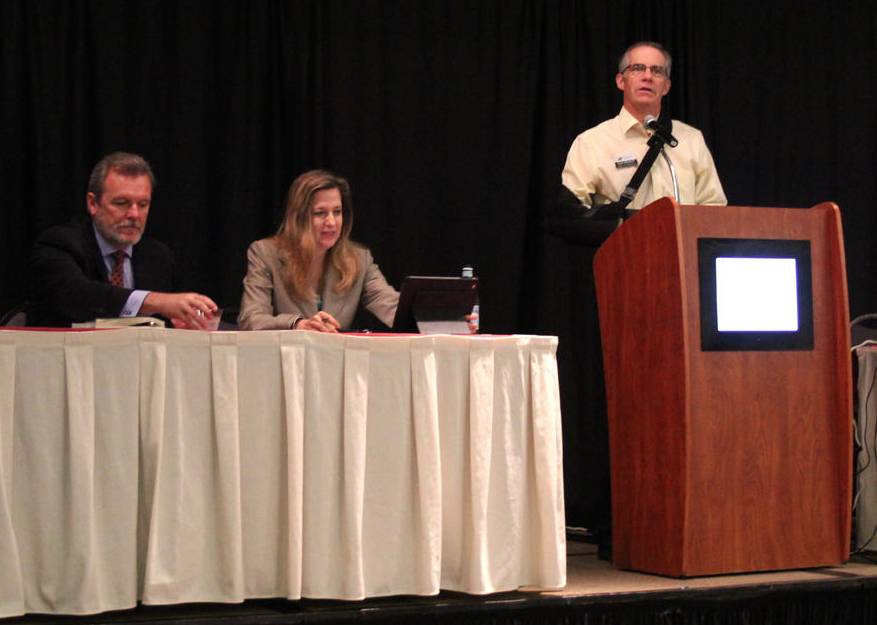
Kansas officials participating in a listening tour on proposed changes to Medicaid waivers for people with seven categories of disabilities included, from left, Mike Randol, director of the division of health care finance at KDHE; KDHE Secretary Susan Mosier; and Kevin Bomhoff, director of strategic development at Wichita State University’s Center for Community Support and Research. CREDIT ANDY MARSO / HEARTLAND HEALTH MONITOR
Cabinet officials say Kansas’ quest to combine Medicaid waivers for people with seven categories of disabilities is intended to provide better care and outcomes, not cost savings.
But costs will go down if care improves as intended, they say.
Officials from the Kansas Department of Health and Environment and the Kansas Department for Aging and Disability Services are beginning a statewide listening tour on the proposed changes after briefing a legislative committee on them Friday.
“What we want to be able to do with waiver integration … is really look at always providing services around the individual and the individual’s needs and not be specifically tied to limitations or restricted by limitations that may be in the individual waivers,” KDADS Secretary Kari Bruffett told the Robert G. (Bob) Bethell Joint Committee on Home and Community Based Services and KanCare Oversight.
Susan Mosier, the secretary of KDHE, stated similar goals to a group of about 75 people who showed up Tuesday for the first stop on the listening tour, the Capitol Plaza Hotel in Topeka.
Mosier said it was time to ditch “disability-defined boxes” in favor of home and community-based services tailored to each individual Kansan, no matter their disability or disabilities.
“Services should be based on a personalized plan of care and centered on an individual’s needs,” Mosier said.
The waiver services are intended to give Kansans with disabilities the support they need to live in their homes and communities rather than institutions.
Waivers services are divided into seven groups: autism, frail/elderly, intellectual/developmental disability, physical disability, serious emotional disturbance, technology-assisted and traumatic brain injury. All offer different types of support services and different limitations on the amount of those services, though there is frequently overlap among the waivers.
The state’s integration plan would merge those seven categories into two pools of services: one for children and one for adults.
After gathering feedback at more than a dozen meetings on the listening tour, state officials plan to post the details of the proposed change Sept. 30. Then there will be a formal public comment period on the proposal through November.
The final language is to be submitted to the federal Centers for Medicare and Medicaid Services on Jan. 4, 2016. Stakeholders then would have another opportunity to deliver public comments directly to federal CMS officials reviewing the proposal.
The changes would go into effect July 1, 2016, pending CMS approval.
‘Cautiously optimistic’
Advocates for people with disabilities on Medicaid have encouraged them to speak up with concerns about changes to their services.
But the people who attended the first listening tour meeting Tuesday were mostly service providers.
One of them was Jamie Price, chief operating officer of Community Living Opportunities, a Lawrence nonprofit that serves people with intellectual or developmental disabilities.
Price said she was “cautiously optimistic” about the waiver integration plan but emphasized that state officials need input from Kansans with disabilities to ensure they “develop the right system that makes sense and affects people positively.”
“I certainly think it brings promises for the beneficiaries to get more fluid, correct services at the right time from the right service provider,” Price said. “It’s a little early to totally understand all the pros and cons.”
Becky Ross, director of Medicaid initiatives for KDHE, told Price and the rest of the audience that the proposed changes were not tied to the state’s ongoing budget problems.
She said combining the waivers was something state officials had intended to do since moving Medicaid to a privatized managed care system called KanCare in 2013.
“This is just something we wanted to do, and now is the right time to do it,” Ross said. “We do believe waiver integration will allow us to save some money and maybe offer services to more people.”
Ross said Medicaid beneficiaries will not lose services in the switch and indeed may gain services that currently fall under a waiver separate from the one tied to their specific disability.
Reduced waiting lists
Ross, Mosier and Bruffett all said that cost savings from combining the waivers ultimately could allow the state to offer services to more people and eliminate waiting lists that some Kansans — particularly those with intellectual disabilities — remain on for years.
The timeline for seeing any cost savings from the change is murky.
During Friday’s hearing, Sen. Laura Kelly, a Topeka Democrat, asked Bruffett where savings would come from if the state serves the same number of people and offers new services to some of them.
“I’m having a hard time figuring out how you’re going to save money,” she said. “The integration actually sounds like it could be a good idea, but I don’t understand how you’re going to save money if you’re going to be providing all of the services to more people.”
Bruffett said it was “certainly a challenge,” but said savings could be seen in the long-term through better coordination of care.
“It is not put forth as a proposal in order to reduce costs,” she said. “It’s actually put forth as a proposal to improve outcomes, which from the beginning of KanCare is how we’ve said we’ll actually reduce costs in time.”
Bruffett said some short-term savings could result from shifting people from more expensive support services to more affordable services they previously weren’t eligibile for but are a better fit for their needs.
Mosier said Tuesday that in addition to allowing the KanCare companies to provide better-fitting services, the waiver change also would reduce duplicative paperwork and allow for a more seamless transition when KanCare members go from one waiver to another.
“We think this approach will result in some efficiencies and some savings that will help us to reduce or eliminate the waiting list,” Mosier said.
Andy Marso is a reporter for Heartland Health Monitor, a news collaboration focusing on health issues and their impact in Missouri and Kansas.
TOPEKA, Kan. (AP) — The Kansas Supreme Court is allowing businesses and trade groups to go forward with a lawsuit challenging a financial maneuver used by the state in 2009 to help balance its budget.
The court issued its ruling Friday. The case received widespread attention after it was filed in 2010 because one of the suing parties’ attorneys was then-House Speaker Mike O’Neal.
The lawsuit challenged a decision by legislators and former Gov. Mark Parkinson to divert fees paid by businesses to finance their state regulators to general government programs instead.
The lawsuit argued the state exceeded its police powers in sweeping the funds and sought to prevent a future repeat.
A Shawnee County judge dismissed the lawsuit, but the state Court of Appeals reinstated it. The Supreme Court upheld the reinstatement.
TOPEKA–Seventh and eighth grade students across Kansas can showcase their creativity and win an education savings account in the 14th annual Learning Quest Make Your Mark Contest. The Learning Quest 529 Education Savings Program is Kansas’ state-sponsored 529 plan, designed to help families invest for their child’s continued education after high school.
This year’s theme is “your future is a clean slate where anything is possible.” Students are being asked to think ahead 20 years from now and explain how they’d be introduced and what they’d discuss if asked to give a commencement speech to the class of 2035 at their former high school. They can choose to respond in one of two categories: the written where they can submit a traditional essay format (up to 350 words) or the creative where they can articulate themselves with a drawing, poetry, collage, video or any other sort of visual response.
“This contest is a perfect fit for our Learning Quest program,” said Kansas State Treasurer Ron Estes, who administers the Learning Quest 529 Program. “It encourages Kansas youth to reflect on future career goals they’ve set for themselves, and consider the training or education they’ll need to achieve those dreams.”
The contest, open to all seventh and eighth grade students in Kansas, begins mid-August, and all entries must be postmarked or submitted electronically at https://essay.LearningQuest.com/ by Oct. 9, 2015.
Prizes include $2,000 Learning Quest accounts for the first-place winner in each of the two categories. Learning Quest judges will also select up to five entries per category to be posted online for public voting for the chance to win the People’s Choice prize of $1,000 per category. Additionally, each of the schools attended by the four winners (the two winners selected by the judges and the two winners by public voting) will receive a $1,000 prize from Learning Quest. Prizes are provided by American Century Investments.
“Since beginning this contest 14 years ago, we’ve had schools continue to support the contest year after year, encouraging students to plan ahead and prepare for their future,” said Estes. “Giving a prize to each of the winning students’ schools is our way of thanking the teachers, principals and school administrators of our Kansas schools for their commitment towards the education of our state’s next generation.”
The Learning Quest 529 Education Savings Program was created to help families invest for their child’s continued education after high school, whether at a traditional four-year college, community college, or technical school. Learning Quest investors benefit from tax-deferred growth and tax-free withdrawals when used for qualified education expenses (tax benefits may be conditioned on meeting certain requirements). Kansas taxpayers can receive a Kansas tax deduction up to $3,000 per child ($6,000 if married, filing jointly) on contributions to Learning Quest or any other 529 plan sponsored by another state.
ST. JOHN- Two Kansas men were injured in an accident just before 2a.m. on Saturday in Stafford County.
The Kansas Highway Patrol reported a 2000 Ford Mustang driven by Callum D. Borthwick, 20, Stafford, was eastbound on NE 20th three miles southeast of St. John when it left the roadway.
The driver overcorrected and the Mustang slid back across the roadway, struck a fence, went airborne over a driveway, and struck a utility pole.
The vehicle came to rest after striking another fence.
Borthwick, and a passenger Jan A. Duplessis, 23, Stafford, were transported to the Stafford County Hospital and then flown to Wesley Medical Center.
They were not wearing seat belts, according to the KHP.