Democrat Gov. Laura Kelly has all-but finished the first of four annual battles with the Kansas Legislature and she had some wins and she had some losses. And the Republican-dominated Legislature? We’re not going to know whether it won or lost until next year’s elections are tallied.
It was 1:34 a.m. Sunday when the House adjourned, and the Senate? Well, it stretched to about 3:08 a.m. before senators headed to their cars after most of the bars had closed in Topeka to start calculating whether they did anything that will assist them in winning re-election.
Medicaid expansion, which was Kelly’s primary issue throughout her campaign and during the legislative session, didn’t happen. The House passed the bill, the Senate refused to even debate it for fear it would pass, and we’re in for another year when more than 100,000 Kansans (the estimates vary widely) won’t have health care, or, more precisely, the caregivers and hospitals mostly in rural areas won’t be paid for that care for Kansans.
And after passing a too-big tax bill during the regular session, lawmakers in the just-ended veto session passed a smaller measure that Kelly probably won’t sign, and we’re down to either a veto of the measure or maybe-but-unlikely allowing it to become law without her signature.
Oh, and yes, we’re in for a summer of debate over whether the tax measure passed 27-13 in the Senate and 83-41 in the House that will mean smaller checks written to the state next year is a tax “cut” for some Kansans or just a reaction to federal tax law changes the Legislature didn’t have anything to do with, making the bill Kansas taxpayer “protection,” or something else altogether.
All we know for sure on the tax issue (adjustment?) is that the state will receive smaller checks from corporations with international operations and that relatively poor Kansans will see no drop in their tax bills.
The budget? Well, best we can tell for now is that it apparently is big enough that the Kansas Supreme Court won’t close down schools next fall, and small enough that even with millions spent to rebuild state government there will still be money in the bank for next session. A little more money for highways, more money for social service and health care for the poor and elderly and raises (2.5 percent) for state employees that wouldn’t make a good tip at a restaurant.
The state’s higher education industry gets more money to hopefully hold down tuition increases and, well, a lot of other smaller, more targeted spending that ought to be locally important in many parts of the state and the legislators who represent them.
The whole story? No. Not for weeks will we see just how the session changed any Kansans’ lives. At this point, there is more spending, there are some bridges that will be given new names, there are prison employees who are looking at raises as high as 15 percent in hopes it will keep them in their jobs, and there is a boost in the amount of income the poor elderly can have and still receive care in their homes.
In the next few weeks, we’ll find out just what happened and to whom, and how the governor casts those changes and how legislators describe their actions with an eye on just what they can use for bullet points on their campaign palm cards next year.
But at least lawmakers are home until the May 29 sine die adjournment, when we see just what happens to their tax bill and whether Kelly line-item vetoes some of that 400-plus page budget she will receive this week.
And then we’ll know how she did…
Syndicated by Hawver News Company LLC of Topeka; Martin Hawver is publisher of Hawver’s Capitol Report—to learn more about this nonpartisan statewide political news service, visit the website at www.hawvernews.com
MANHATTAN — Paul and Sandra Edgerley, Brookline, Massachusetts, have given $20 million to the College of Business Administrationat Kansas State University. The gift is to support the college’s recently adopted five-year strategic plan and vision to become a transformational leader in business thought and education through knowledge creation, innovative programs and extraordinary experiences.
Paul and Sandra Edgerley photo courtesy KState
According to a media release from KSU, in order to realize the full benefits of the strategic plan, the college seeks to double its endowment from $50 million to $100 million by 2021, and the Edgerley gift gets them nearly halfway to that goal. The Edgerleys’ gift funds a new Digital Learning Repository, a new Center for Financial Analysis, and enhances efforts in four key areas: corporate engagement, student recruitment, branding and marketing of the college, and data-driven decision making.
“Paul and Sandra Edgerley have made a truly transformative investment in the future of the College of Business Administration,” said Kevin Gwinner, Edgerley family dean of the College of Business Administration. “However, more than just investing, they have helped us craft a strategic plan to fulfill our vision of being the premier business school in the region. This plan is metric driven, sets specific goals and provides for accountability. This investment will allow us to continue to elevate the educational quality, reputation and stature of the college. Further, it is serving to motivate others to consider how they can play a role in this transformation as we drive toward doubling the endowment of the college from $50 million to $100 million over the next three years.”
The college has set ambitious strategic goals for its future, and the increased funds will empower the college to get results. Here are a few of these goals:
• Increase the four-year graduation rate.
• Grow the college by 500 students, including increasing the multicultural student population.
• Increase engagement between students and companies in terms of quantity and quality.
• Increase the number of students participating in internships.
• Increase the number of job offers to students.
•Increase the average starting salaries of graduates.
Paul Edgerley received his degree in accounting from Kansas State University in 1978. In 2004, Edgerley was named the Distinguished Business Leader of the Year by the college and was inducted into the college’s Business Leaders Hall of Fame. In 2011, he was inducted into the college’s Accounting Hall of Fame. Edgerley serves on the Dean’s Advisory Council for the College of Business. Paul Edgerley is a managing director and co-founder of VantEdge, a private investment group focused on building excellent companies. He previously served as a managing director at Bain Capital from 1990 until his retirement in January 2016. Since his retirement, he continues to serve as a senior advisor to Bain Capital and a number of Bain’s portfolio companies.
“We are proud to have worked with Paul and Sandra Edgerley on this incredible gift to the College of Business Administration,” said Greg Willems, president and CEO of the KSU Foundation. “In addition to this recent investment, the Edgerleys have made a number of other gifts to the business college, funding scholarships, endowing the dean’s position and faculty chairs, funding the development of the college’s career counseling program, and they made a cornerstone donation toward the construction of the college’s new building. The Edgerleys’ generosity and impact will substantially elevate outcomes for our students and companies looking for premier talent. We are truly fortunate to have their friendship and a shared vision for the future of our great university.”
The Edgerleys see their investments in Kansas State University as a way to give back and to advance future endeavors.
“Sandy and I are great believers in the importance of the business college strategic plan and see this as a unique opportunity to give back to the university that has had such a profound impact on my life,” Paul Edgerley said. “We believe funding the college strategy will continue to transform the business college, ensuring K-State business students get a differential education, find great jobs and ultimately have successful and meaningful lives and careers. These students will become tomorrow’s leaders. They will build successful businesses, create good jobs for Kansas residents and be successful alumni who, 20 years from now, will give of their time and money to support future generations of Kansas State students.”
The College of Business Administration’s comprehensive vision for success is represented by five strategic pillars: build and maintain a world-class learning facility, offer scholarships to attract the best students and address affordability, provide innovative and applied educational programs and experiences, support inspirational faculty and staff, and ensure students find and are prepared for extraordinary careers.
The Edgerleys’ gift not only benefits the College of Business Administration but also Kansas State University as a whole.
“Paul and Sandra Edgerley exemplify the generosity of the K-State family,” said Richard Myers, university president. “Their investment in the success of College of Business Administration faculty, students and programs not only elevates the college but brings prestige to the university and helps propel K-State toward being nationally recognized as a Top 50 public research university.”
SHAWNEE COUNTY—Law enforcement authorities are investing a shooting that sent one man to the hospital and have made an arrest.
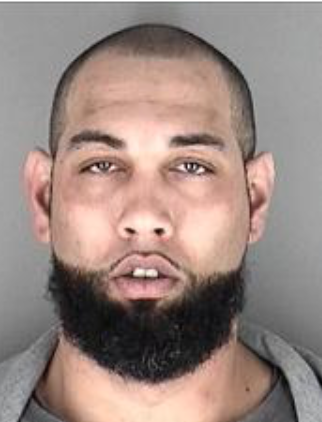
Jones photo Shawnee Co.
Just after 8 a.m. Monday, the Shawnee CountyCommunications Center received reports of a possible shooting at the Traveler’s Inn, 3846 SW Topeka Blvd. in Topeka, according to police spokesperson Gretchen Koenen.
At the scene, police located an adult male who appeared to be suffering from an apparent non-life threatening gunshot wound. The suspect was transported by American Medical Response to a local hospital.
A preliminary investigation indicates that a bail bondsman was on the second floor of the Traveler’s Inn attempting to take the suspect into custody on a misdemeanor warrant for escape from custody.
The suspect grabbed a large metal lamp and attempted to strike the bail bondsman. The bail bondsman then fired his weapon, striking the suspect. The bondsman was not injured in the incident.
Police later learned the man who fired the gun was not a bail bondsman, according to Lt. Robert Simmons.
Police arrested Durante Dewayne Jones, 36, and booked him into the Shawnee County Department of Corrections for Aggravated False Impersonation, Bail Enforcement – Unlawful Acts and Criminal Possession of a Firearm by Felon.
—————-
SHAWNEE COUNTY—Law enforcement authorities are investing a shooting that sent a suspect to the hospital.
Just after 8 a.m. Monday, the Shawnee CountyCommunications Center received reports of a possible shooting at the Traveler’s Inn, 3846 SW Topeka Blvd. in Topeka, according to police spokesperson Gretchen Koenen.
At the scene, police located an adult male who appeared to be suffering from an apparent non-life threatening gunshot wound. The suspect was transported by American Medical Response to a local hospital.
A preliminary investigation indicates that a Bail Bondsman was on the second floor of the Traveler’s Inn attempting to take the suspect into custody on a misdemeanor warrant for escape from custody.
The suspect grabbed a large metal lamp and attempted to strike the Bail Bondsman. The Bail Bondsman then fired his weapon, striking the suspect. The Bail Bondsman was not injured in the incident.
All individuals were accounted for and there was no threat to the public, according to Koenen.
The case will be forwarded to the District Attorney’s Office for charging consideration as is standard protocol. Further information will be released when we are able to.
Monday evening’s round of severe weather saw reports of large hail in McPherson, Saline and Pawnee Counties, flooding rain and one tornado in Edwards County, according to the National Weather Service.
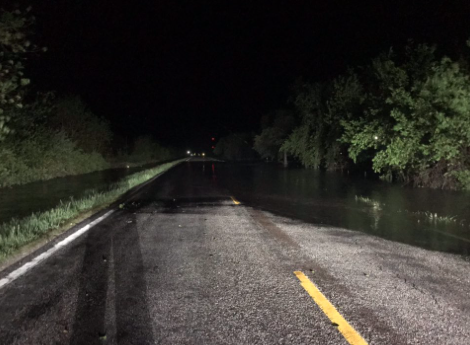
The large hail was responsible for causing the most damage. There are no reports of injury. The National Weather service has issued many flash flood watches and warnings and roads in many areas are closed due flooding. More rain is in Tuesday ‘s forecast for a majority of the state.
— Greenwood County Emergency Management (@gwcountyem) May 7, 2019
The large hail was responsible for causing the most damage. There are no reports of injury. The National Weather service has issued many flash flood watches and warnings and roads in many areas are closed due flooding including U.S. 56 in Pawnee County between Larned and U.S. 183. Tuesday ‘s forecast calls for more rain across Kansas.
MEADE COUNTY — One person died in an accident just before 10a.m. Monday in Meade County.
The Kansas Highway Patrol reported 2011 Dodge Charger driven by Wendy Lynn Torres, 48, Plains, was westbound on U.S. 54 twenty-seven miles west of Plains. The driver pulled onto the right shoulder.
A westbound 2017 Volvo semi driven by Gary Wayne Dochow, 60, Wichita, observed the Dodge come to a stop and moved to the east bound lane to pass. The Dodge then pulled out turning into the path of the semi.
Torres was pronounced dead at the scene and transported Brennemans Funeral Home in Liberal. Dochow was transported to the hospital in Meade.
TOPEKA – Kansas Department for Aging and Disability Services (KDADS) Secretary Laura Howard announced today she has appointed Andrew Brown to serve as Commissioner for the agency’s Behavioral Health Services (BHS) Commission.
Brown, who has more than 20 years of experience in human services program management, has served in the role of interim commissioner since October 2018 after starting his career at KDADS as the BHS Prevention Program Manager. He came to KDADS from Headquarters, Inc. in Lawrence, Kan., where he served as executive director. Brown also holds a volunteer position on the City of Lawrence Affordable Housing Advisory Board and previously held several prominent volunteer positions in the industry, including the Governor’s Behavioral Health Services Planning Council Prevention Subcommittee and the Kansas Mental Health Coalition.
“Naming Andy commissioner to lead our behavioral health services programs aligns seamlessly with this agency’s strategic vision of developing a culture of continuous improvement,” said Secretary Howard. “Since being named interim commissioner last year, he has proven time and again his commitment to finding solutions that improve the lives of some of the state’s most vulnerable citizens.”
Brown earned a Bachelor of Applied Sciences in Human Services degree from Washburn University in 2010 and a Master of Social Work, Concentration in Administration, Advocacy and Policy, from the University of Kansas in 2012. He is a 2016 Washburn University Alumni Fellow and a 2015 Leadership Lawrence Alumni.
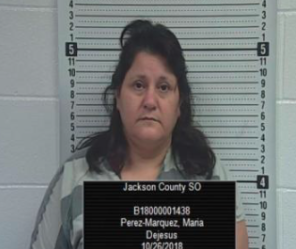
HOLTON, Kan. (AP) — A Nebraska woman involved in a crash that killed three Kansans will be sentenced in June after accepting a plea agreement.
Maria De Jesus Perez-Marquez photo Jackson County
Jackson County Attorney Shawna Miller confirmed Monday that 49-year-old Maria Perez Marquez, of Omaha, pleaded guilty in April to three misdemeanor counts of vehicular homicide and one felony count of aggravated battery. She had originally been charged with three felony counts of involuntary manslaughter.
The November 2017 crash on U.S. 75 killed three family members of two Sabetha High School football players shortly after their team won a state title.
The Kansas Highway Patrol said Perez-Marquez was trying to pass another vehicle about 12 miles north of Holton when her vehicle hit a minivan driven by 42-year-old Carmen Ukele, of Sabetha. The crash killed Ukele, her daughter and her brother-in-law.
KANSAS CITY, KAN. – A California trucker working for a Kansas freight brokerage pleaded guilty Monday to stealing a load of meat valued at more than $160,000, according to U.S. Attorney Stephen McAllister.
Gegham Avetisyan, 37, Valley Village, Calif., pleaded guilty to one count of wire fraud. Avetisyan contracted with a trucking freight brokerage business in Olathe to deliver a load of meat to three locations in California.
He faxed documents to the company in which he used the name Robert Ivanov. He picked up the meat at a packing plant in Omaha, but never delivered it.
Sentencing is set for Aug. 12. He faces a sentence of up to 20 years in federal prison and a fine up to $250,000. McAllister commended the FBI and Assistant U.S. Attorney Chris Oakley for their work on the case.
WICHITA, Kan. (AP) — Authorities say a man and woman in a stolen SUV involved in a crash that killed two people are both convicted felons.
Christoper English has previous convictions for drugs, weapons and flee or elude law enforcement, according to the Kansas Department of CorrectionsFirst responders on the scene of the fatal Sunday accident -photo courtesy KAKE
Police say 24-year-old Mia Collins led police on a chase Sunday in a stolen BMW sport utility vehicle. After about 1 mile the car collided with a car and another SUV at an intersection.
The crash killed 70-year-old Maria Wood and 12-year-old Rosemary McElroy and critically injured 36-year-old Jenny Wood, a popular Wichita musician known for performing with children. She is Wood’s daughter and McElroy’s aunt.
Collins is on probation. A passenger in her car, 38-year-old Christopher English, is on parole.
The driver of the SUV that was hit, 65-year-old Alfred Angle, was seriously injured. Collins and English also were taken to a hospital.
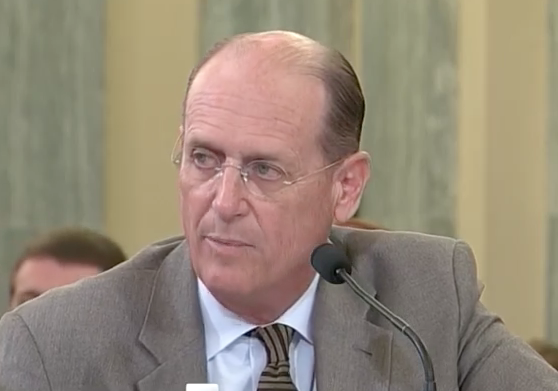
TOPEKA, Kan. (AP) — U.S. Sen. Jerry Moran is putting pressure on Amtrak to commit to the continued operation of the Southwest Chief passenger rail service that connects Chicago to Los Angeles with stops in Kansas.
Amtrak CEO Richard Anderson testifies before a Senate Committee -image courtesy CSPAN
Moran recently delayed confirming three nominees to Amtrak’s board of directors in an effort to push the national rail carrier to offer assurances that the line will operate for at least another year, the Topeka Capital-Journal reported.
Amtrak’s president, Richard Anderson, agreed to meet with Moran and other lawmakers about the rail service’s future later this month.
Amtrak officials considered suspending rail service from Dodge City to Albuquerque, New Mexico, and transitioning to buses last year. The idea stemmed from the cost of repairs needed along a portion of the route.
The Republican senator was behind a federal budget compromise approved by Congress in February that provides an additional $50 million to go toward maintenance and safety improvements of the Southwest Chief line. Discussions in Congress about extending funding are ongoing.
“As the divide between urban communities and rural communities in America continues to expand, passenger rail services, like the Southwest Chief, are necessary in connecting Kansans to the rest of the country,” Moran said. “I am continuing to seek assurances from Amtrak that it will uphold its commitment to repair, improve and continue the Southwest Chief rail line.”
Moran and a group of lawmakers also sent Amtrak officials a letter requesting information about the route. Last year’s ridership information hasn’t been made available yet.
More than 52,000 passengers boarded the Southwest Chief line in Kansas in 2017, which was an increase of 2,700 people from the previous year.
—————-
ByCORINNE BOYER, Kansas News Service
Long-running frustration about Amtrak’s willingness to keep a rail passenger line running through remote parts of the country has politicians threatening to block new directors to the agency.
Amtrak has yet to respond to senators about the future of its long-distance routes. WIKIMEDIA COMMONS
A handful of U.S. senators demanded specifics by this week about how Amtrak plans to spend an added $50 million to keep the Southwest Chief line running from Chicago, through Kansas, to Los Angeles.
Hoping to force Amtrak to make long-term promises of keeping the Southwest Chief line, U.S. Sen. Jerry Moran of Kansas had already used the power each senator holds to put a legislative block on the appointment of three nominees waiting to join the passenger rail agency’s board of directors.
Amtrak still has not specified when it will answer the pending questions from the Senate. A spokeswoman from Moran’s office said Amtrak has made contact, but not with answers about how it plans to alter long-distance routes or how the rail service calculates what states must chip in to support service.
“(Moran) will maintain those holds (on the nominations until he gets) assurances from Amtrak that it will continue to fund the Southwest Chief and funds that rail service,” said Moran spokeswoman Morgan Said.
Moran and other senators have criticized Amtrak for proposals to replace train services with buses along some parts of the route.
Amtrak officials did not respond to requests for comment for this story.
In February, Congress gave $50 million for upkeep of the route to Amtrak to keep the line working through September. Last year, Amtrak proposed replacing service from Dodge City to Albuquerque with buses, but the federal budget prohibits the use of buses to replace long-distance train service along the route.
In early April, a group of 11 senators sent Amtrak a letter demanding more detail about its plans for the Southwest Chief and how, more broadly, it decides which long-distance routes are worth operating.
The Senate letter also addressed Amtrak’s claims that ridership is down. The most recent data provided by Amtrak says more than 52,000 passengers boarded the Southwest Chief line in Kansas in 2017, up 5.7 percent from 2016.
With 2 a.m. and 3 a.m. departures, Newton, the busiest station in the state, saw nearly 16,000 passengers in 2017. Erin McDaniel, communications director for the City of Newton, says the town supports the Southwest Chief and partners with other cities to fund it.
“We know many of our residents use it to get to Chicago as well as the Southwest,” McDaniel said.
Keeping the Southwest Chief running is important to Newton because preliminary efforts looking at establishing train service to connect Newton to the Heartland Flyer route, which runs from Oklahoma City to Fort Worth, Texas, are underway.
“There used to be a train route that went there years ago,” McDaniel said, “but if the Southwest Chief goes away, dreams of extending the Heartland Flyer would go away with it.”
Over the last year, Amtrak has removed ticket agents from many stations. But Assistant City Manager for Dodge City Melissa Mccoy said the city employs staff at its train depot.
“We have few options in terms of public transportation,” McCoy said. She said ridership jumps with tourists in the summer.
Without the Southwest Chief route, McCoy says some Dodge City residents wouldn’t be able to travel long distances.
“We have a lot of working class folks, and they have limited income,” she said. “Amtrak provides them a way to visit family and go on vacation and without that they might not have it all.”
An earlier version of this story incorrectly attributed the reason a hold was placed on Amtrak directors’ appointments. U.S. Sen. Jerry Moran took that action to secure a pledge to keep the Southwest Chief line running.
Corinne Boyer is a reporter based in Garden City for the Kansas News Service. Follow her @Corinne_Boyer.
Photo courtesy of Hutchinson Regional Airport.Hutch Post
HUTCHINSON – A lightning strike damaged the main apron of the Hutchinson Airport Sunday evening.
Airport Manager Pieter Miller said he got the call from the flight control tower Sunday night.
“About 7:15 or so, I got a call from the control tower and they reported the main apron just east of the restaurant here and that it blew chunks of concrete in each direction,” Miller said.
Miller said lightning strikes happen at the airport on occasion, but the damage this strike caused was extreme.
“I wouldn’t say it happens quite often, although we have been hit by lightning lots of time out here over the years. This is the most damage that I’ve seen happen at one time,” he said. “We’ve had a couple of hits on runways and of course, all of our windsocks and things like that get hit. I’ve never actually seen it blow a 6-by-10-foot chunk up in the air.”
WICHITA, Kan. (AP) — The process of obtaining a new Real ID is creating headaches for some Kansas residents.
Real ID license
Vietnam War veteran Armando Fleming is among several Kansas residents who have left driver’s license offices empty-handed after learning that the documents they brought to verify their identity weren’t enough to get approved for a Real ID.
The credential will be required under federal law to board airplanes and enter some federal buildings beginning next year. Congress passed the Real ID Act in 2005 as a security measure following the Sept. 11 terrorist attacks. Many states have been waiting to come into compliance closer to the Oct. 1, 2020, deadline.
Fleming, a Wichita retiree, was initially denied a Real ID with the name he’s been using his entire life because it doesn’t match the name on his birth certificate, the Wichita Eagle reported.
“I pulled out military records, discharge records, my awards . and I took them down (to the DMV) and the guy said, nope, it won’t satisfy the requirements” he said. “Needless to say, I started to get a little upset because I spent 15 years in the Army and fought for my country and got wounded for my country. I didn’t think I needed to prove who I was.”
The veteran’s documents listed Fleming as his last name, but they conflicted with his birth certificate.
Fleming’s maternal grandmother had filled out his birth certificate with his mother’s last name, Robinson. But he ended up using his father’s last name, Fleming, and didn’t even know about the issue until years later.
To obtain a Real ID, residents must present proof of their current legal name with a birth certificate or passport, as well as documents proving a social security number and residence. Individuals whose names don’t match their birth certificates or passports have to show additional documentation that traces their name changes, such as marriage, divorce or adoption records.
Fleming had to go to court and spend $204 to legally change his name so that he could get a Real ID with the name he’s been called for 74 years.
The Kansas Department of Revenue has acknowledged that some people are seeking legal name changes to obtain a Real ID that matches the rest of their personal, military, school and financial documents.
Kent Selk, the department’s driver services manager, said it’s a problem that mostly affects older residents.
“The state’s just upholding the federal law,” Selk said. “We’re following all of the guidelines from the federal government that says this is what you have to do to issue this credential.”
It’s unclear how many people across Kansas have changed their name to obtain a Real ID, or how many have decided not to apply for one because of the trouble or cost of getting a legal name change.
According to the department, more than 40% of Kansas’ 2 million licensed drivers have a Real ID.
In the waning days of the 2019 session, the conservative Republicans controlling the Kansas Legislature made one thing clear to Democratic Gov. Laura Kelly and her allies: They were ready for a fight against Medicaid expansion.
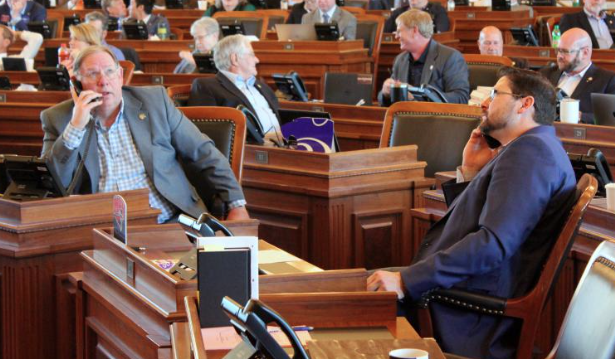
Republican Majority Leader Rep. Dan Hawkins (left) and Kansas House Speaker Ron Ryckman worked the phones to secure enough votes to end a standoff over Medicaid expansion and pass the budget to end the legislative session.. STEPHEN KORANDA / KANSAS NEWS SERVICE
The issue commanded the four-month session, which ended in the wee hours Sunday. The session was the first with the new Democratic governor in office, which gave people who wanted to expand health coverage for thousands of low-income Kansans the energy to push hard in the final days. Their efforts ultimately failed.
“Medicaid expansion has characterized this entire session,” Democratic Rep. Elizabeth Bishop said during a final budget vote. “It has run up against the will of the minority to thwart the will of the majority.”
Conservative leaders in the House convinced enough Republican moderates to fold to break a logjam over expansion and approve a budget that boosts funding for roads, prisons, and education.
“Our ultimate goal was to make sure that we funded core government and that our schools were funded,” Republican House Speaker Ron Ryckman said.
Everyone involved agreed this wasn’t the last word on Medicaid expansion. House Democratic Leader Tom Sawyer said “we gave it our best fight, and we’re going to keep fighting.” Senate Majority Leader Jim Denning, who refused to debate it this year, promised to prepare a “much more robust” bill before the 2020 legislative session starts in January.
But that’s all in the future.
While Medicaid expansion stalled, other initiatives advanced and faltered in 2019.
What lawmakers did.
Increased school funding, yet again.
Lawmakers handed Gov. Laura Kelly a victory by approving her K-12 education proposal with a bipartisan majority.
Kelly based her plan on calculations from the Kansas Department of Education, adding about $90 million per year to account for inflation. The Kansas Supreme Court must sign off; if they do, it will end a long-running lawsuit over education spending.
But the plaintiffs in the Gannon case say the state got the math wrong, and that the Legislature will have to put in more still to make school funding adequate. Oral arguments are on May 9.
Gave businesses and itemizers a tax break.
In late March, Kelly quashed tax-relief legislation that was crafted in response to changes at the federal level. Lawmakers successfully tried again at the end of the session, passing a more modest bill.
It will save Kansas residents used to itemizing from paying more in state taxes after changes to the federal tax code. And it will exempt corporations’ overseas income from state taxes.
That’s if the governor doesn’t veto this bill too. She’s called the measure hasty and wants to instead study the Kansas tax code over the coming year.
Lawmakers tried to make it more palatable by including provisions to cut the sales tax on food, which Kansas taxes more than almost any other state. Kansas would collect sales taxes from more online retailers to make up for it.
Let the state Farm Bureau market health coverage.
Citing the rising cost of health care, the Kansas Farm Bureau lobbied lawmakers to market coverage exempt from state insurance regulations and the rules put in place by the federal Affordable Care Act.
Critics said the group shouldn’t be allowed to sidestep insurance regulations, especially when it comes to guaranteeing coverage for pre-existing conditions. But the farm bureau argued the flexibility will create new, cheaper health plans that their members could afford.
The governor expressed reservations, but let the bill become law without her signature, in part to encourage a compromise on Medicaid expansion.
Approved more money for prisons, with a twist.
Kelly offered a last-minute budget amendment to boost corrections spending by about $30 million. The administration is hoping that raising officers’ pay and moving some inmates to county jails and private prisons will ease the pressure on the state prison system.
Lawmakers ultimately included more than $25 million, but there’s a catch: the money’s being routed through the state Finance Council. It’s made up of the governor and leaders of both parties, who all will decide on actually doling out the funding.
Took baby steps toward fixing the child welfare system.
The across-the-board consensus to start off the session was that children dying on the state’s watch and kids sleeping in offices of overwhelmed foster care contractors constituted an emergency.
Lawmakers agreed to add staff for the Department for Children and Families to lighten the load, including more child abuse investigators. They also agreed to funding programs that will allow the state to get federal money to help struggling families stay together.
But most recommendations of the state’s child welfare system task force remained on the shelf, things like improving foster home recruitment and strengthening safety-net programs like Medicaid. And lawmakers cut support for child welfare oversight from the final budget.
Restored some funding for state colleges and universities.
Kelly wanted $8.9 million to fully restore what lawmakers had cut during the state’s lean financial years.
Lawmakers agreed and added more, boosting spending on colleges and universities by almost $16 million, plus about $4 million in additional funding targeted at specific programs, including a technical education initiative.
Overall, it’s still less than the $50 million the Board of Regents had requested, but the regents said they were thankful for what they got.
Got some highway projects rolling again.
Lawmakers routed extra money to speed up projects in the 10-year transportation plan, T-WORKS, that had been delayed due to the post-2012 tax-cut budget crunch.
A task force recommended finishing the delayed highway projects, and lawmakers agreed to pursue that before working a on a new long-term transportation plan.
Made it easier to vote, and get your ballot counted.
Another piece of the legislation allows voters to fix problems with the signature on their mail-in ballot. In some cases, ballots have been thrown out because county officials said the signature didn’t closely match an example on file. The new law will require county officials to try to contact voters and let them correct their ballot before all the votes are tallied.
The Legislature did not, however, revoke the Kansas secretary of state’s authority to prosecute election crimes. The move had broad support, and the endorsement of current Secretary of State Scott Schwab, but lawmakers ran out of time.
Allowed medical use of CBD oil containing some THC.
THC, the psychoactive ingredient in marijuana still isn’t legal in Kansas. But lawmakers made allowances for having CBD oil with THC in it for medicinal purposes.
Patients and caregivers who have a doctor’s note will be protected against prosecution and child welfare proceedings. Republican Rep. Eric Smith, a sheriff’s deputy, said such a letter won’t necessarily protect against being arrested for possessing CBD oil containing THC.
What lawmakers did not do.
Amend the state constitution to ban abortion.
The Kansas Supreme Court ruled last month that the state constitution guarantees a right to abortion. Abortion opponents say that could knock down many of the restrictions that have been added to state law in recent years.
The court’s long-awaited decision amplified calls for a constitutional amendment, which would need two-thirds support in the Legislature to get on the ballot for a public vote. Abortion opponents are waiting until 2020 to make their push for that.
Legalize sports betting.
It has bipartisan support, but legalizing betting on sports turned out not to be a slam dunk. While eight states already have done it and two others look to be in line, Kansas lawmakers got hung up on who should run gambling, how much to tax betting and other nitty-gritty details. The issue will likely come back in the 2020 session.
Refinance the state pension program.
Kelly wanted to stretch out repayment of state pension debt to free up money for other priorities, like highways and Medicaid expansion. But the proposed refinancing might have increased overall costs by $7 billion. Lawmakers scoffed and chose not to pursue it. Still, the reamortization idea could rerturn in the coming years.
Expand Medicaid.
Democrats and moderate Republicans maneuvered to get Medicaid expansion passed in the House in March. With the goal of inducing a debate on expansion in the Senate, the coalition blocked the budget twice as the session wound down.
Despite the bipartisan majorities in both the House and Senate, and popular support, Republican leaders held off the last-ditch efforts.