In the time I have spent in public service, I have been privileged to be a part of some important legislative changes and met some incredible people in the process.
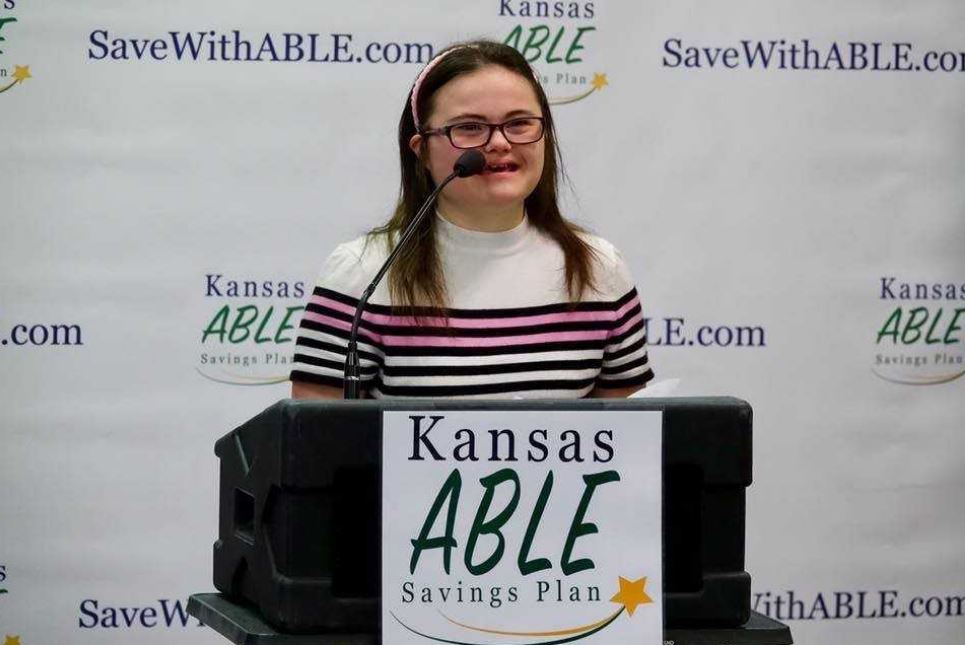
One of my favorite experiences that brings together both of these things happened in 2017 when I got to meet Rachel Mast. Rachel is a vibrant young woman who just finished her first semester of college, loves to be active in her community, and spreads her contagious enthusiasm for life to everyone she meets. She was also born with Down syndrome.
Rachel has the distinct honor of being the first individual to open a Kansas ABLE savings account, which became available just a few short years ago when my fellow legislators and I passed the ABLE Act through the Kansas Legislature.
ABLE accounts are new to Kansas and created specifically for people living with a disability. Those within the disabled community and the family members tied to the community often face the hardship of higher medical costs, along with other disability-related expenses. Prior to the ABLE Act’s passage, saving money was often a tricky issue for the disabled community. Saving more than $2,000 in one’s name could jeopardize that individual’s eligibility for necessary benefits such as SSI and Medicaid. ABLE accounts were designed to alleviate that savings restriction, and in turn give individuals living with a disability and their families the freedom to plan ahead and save for a more secure future without the worry of losing much needed public assistance.
Rachel Mast
An ABLE account for Rachel has allowed her to experience things in life that were previously financially out of reach. Rachel now attends college and is using the saved funds within the account to pay for parts of her higher education. Rachel now has a job where a portion of her earnings go into her ABLE account and her desire to work and earn an income is not limited by a $2,000 savings cap. Rachel now has an achievable dream where she can save a sizable amount of money in order to make a down payment on the pink house she’d like to own one day.
It has been very heart-warming from my vantage point now in the Kansas State Treasurer’s office, where we administer ABLE accounts, to see these accounts being opened and the disabled community feeling the relief of being able to save for the future. As awareness of ABLE accounts grows it is my hope that more and more families caring for a disabled family member will consider this path of saving.
For Rachel, ABLE has been a key to opening new doors that will assist her in living an independent and fulfilling life. We at the Treasurer’s office are excited to continue assisting more Kansans with opening ABLE accounts that we hope will allow them to live their best life as well.
For more information on how to get started with an ABLE account for yourself or a family member, please give our office a call at 785-296-7950.
PRATT – Kansas Wildlife, Parks and Tourism (KWPT) Commissioners met on June 13 at the Rolling Hills Zoo in Salina to conduct their 5th public meeting of the year. There, Commissioners voted on and approved deer season dates for select military installations, and the statewide antelope season.
Passing 7-0, Commissioners approved deer season dates for the following military installations:
Fort Riley
Youth and hunters with disabilities – Oct. 12-14, 2019
Firearm – Nov. 29-Dec. 1, 2019 and Dec. 14-22, 2019
Commissioners also approved 2019 statewide antelope seasons as follows:
Archery – Sept. 21-29, 2019 and Oct. 12-31, 2019
Firearm – Oct. 4-7, 2019
Muzzleloader-only – Sept. 30-Oct. 7, 2019
The next KWPT Commission meeting is scheduled for Thursday, August 15, 2019 at the University of Kansas Edwards Campus – Best Conference Center, 12600 Quivira Road in Overland Park.
MANHATTAN — Farmers who planted cover crops on prevented plant acres will be permitted to hay, graze or chop those fields earlier than November this year, the U.S. Department of Agriculture (USDA) announced June 20.
USDA’s Risk Management Agency (RMA) adjusted the 2019 final haying and grazing date from November 1 to September 1 to help farmers who were prevented from planting because of flooding and excess rainfall this spring.
“I thank USDA for recognizing the impact the flooding and excess rainfall have had on farmers this spring,” said Kansas Secretary of Agriculture Mike Beam. “This adjustment will provide a new opportunity for some producers who are seeking alternatives in response to prevented planting because of excess moisture.”
RMA has also determined that silage, haylage and baleage should be treated in the same manner as haying and grazing this year. Producers can hay, graze or cut cover crops for silage, haylage or baleage on prevented plant acres on or after September 1 and still maintain eligibility for their full 2019 prevented planting indemnity.
“We made this one-year adjustment to help farmers with the tough decisions they are facing this year,” said Under Secretary for Farm Production and Conservation Bill Northey. “This change will make good stewardship of the land easier to accomplish while also providing an opportunity to ensure quality forage is available for livestock this fall.”
Other USDA Programs Other USDA agencies are also assisting producers with delayed or prevented planting. USDA’s Farm Service Agency (FSA) is extending the deadline to report prevented plant acres in select counties, and USDA’s Natural Resources Conservation Service (NRCS) is holding special sign-ups for the Environmental Quality Incentives Program in certain states to help with planting cover crops on impacted lands. Contact your local FSA and NRCS offices to learn more.
TOPEKA – A new study discovers a strong connection between attending afterschool reading interventions and a child’s early reading proficiency.
The study commissioned by the Reading Roadmap (RR) suggests afterschool programming that includes structured reading interventions aligned with school-day data can accelerate significantly literacy proficiency among young, striving readers.
This study analyzed school individual-level data of 9,000 elementary students across 58 different schools over the 2017-18 academic year. The study compiled data from school-administered reading assessments including AIMSweb, DIBELS and FastBridge. The study compared progress toward reading benchmark among elementary-age children that attended school-based afterschool programs with those that did not.
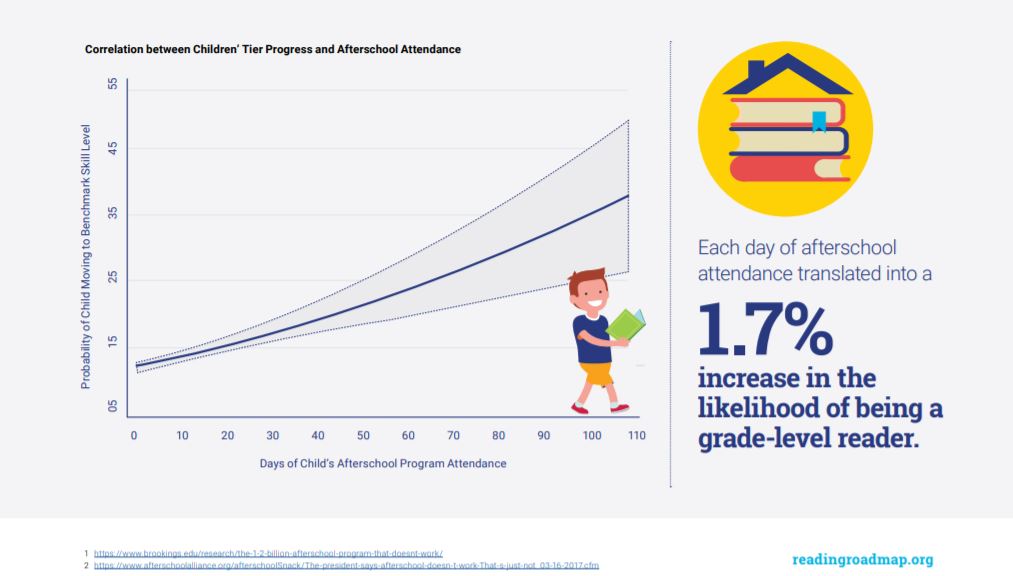
The study found children attending after school reading interventions were 26% more likely to reach benchmark than their non-attending peers. According to the study’s author, Mustafa Yilmaz, “The effect of the relationship was equivalent to a 1.7% greater chance of achieving benchmark reading for every day a child attended after school. That is quite significant.”
The study suggests that structured afterschool reading interventions, when done in concert with school instruction, can accelerate overall reading progress.
“When a child enters kindergarten, it’s a four-year race for her to learn how to read,” said Andrew Hysell, RR Director. “If she cannot achieve early reading proficiency by the third grade, she will face barriers for the rest of her life.”
Supplemental tutoring outside the school day is considered essential for a reader that is behind. For example, the Center for American Progress prioritizes “provid[ing] a tutor for every child performing below grade level” as its number one recommendation to improve education.
Unfortunately, families without resources cannot pay for professional tutoring, and families in rural communities often lack any high-quality options regardless of cost. Therefore, afterschool programs are the only option for these families and their children.
“School-based afterschool reading intervention is literally their only lifeline,” said Hysell. “The evidence continues to pile up that afterschool programs can be an effective delivery device for high-quality reading interventions for children that need them,” said Hysell. “Let’s continue to invest in after school and get more educational value out of our existing programs for the good of all children.”
● Students who attend after school interventions regularly saw their probability of moving to benchmark increase by an average of 26%;
● The predicted probability of students reaching benchmark reading who attended RR afterschool programs was as high as 38% greater than their non-attending peers; and
● Each day of after school attendance translated into a 1.7% increase in likelihood of being a grade-level reader.
The RR provides a structured after school reading program supporting children PK-3. The model aligns with school-tiered systems of support and provides reading interventions in the five pillars of early literacy: phenome awareness, phonics, fluency, vocabulary and comprehension.
An initiative of the Kansas Department for Children and Families (DCF), the Reading Roadmap began in the fall of 2013. DCF recognized the importance of early literacy and understood its connection to success in school and prosperity in life.
While not involved directly with education, DCF funded childcare, afterschool, and family programs targeting low-income populations and believed these types of social service programs could be used in partnership with schools to promote early literacy. To pursue that objective, DCF commissioned the Kansas Reading Roadmap to find innovative strategies for afterschool, summer, and family engagement programs to promote early literacy.
MANHATTAN – The American Legion Department of Kansas’ Boys State Committee has appointed Shane Wilson to serve as the executive director of the American Legion Boys State of Kansas Leadership Academy.
Wilson’s three-year term began on June 8 at the close of the 2019 ALBSKLA session. He takes over for Jake Ellis who served in the role for the past four years.
Wilson, a resident of Lawrence, Kan., was a Kansas Boys State delegate in 2006 from Abilene High School before graduating there in 2007. He has served KBS in a variety of volunteer positions since 2007, most recently as its dean of counselors for the last two years. Wilson previously served Kansas Boys State as a general advisor in 2017, as a coordinator from 2014-16 and in various counselor roles from 2007-13.
Wilson is employed as a product support specialist for PROSOCO Inc., in Lawrence. He earned a Bachelor of Science degree in economics from Emporia State University in 2014. Wilson is pursuing Master of Arts in educational leadership from Saint Mary’s University (Minn.). He is a member of the
Shawnee Tribe of Indians based in Miami, Okla.
As executive director for the American Legion Boys State of Kansas Leadership Academy, Wilson is responsible for the direction and oversight of all objectives for the program. Along with implementation of strategic planning and visioning, Wilson is accountable for the long-term health and longevity of the
ALBSKLA and its resources.
The ALBSKLA provides a relevant, interactive, problem-solving experience in leadership and teamwork that develops self-identity, promotes mutual respect and instills civic responsibility. Boys State is a “learning by doing” political exercise that simulates elections, political parties and government at the state, county and local levels, providing opportunities to lead under pressure, showcasing character and working effectively within a team. It’s also an opportunity to gain pride and respect for government and the price paid by members of the military to preserve democracy.
Approximately 410 young men from across the State of Kansas, all of whom will enter their senior year of high school this fall, participated in the 2019 session of the American Legion Boys State of Kansas Leadership Academy. The event, which concluded its 82nd year, was held June 3-8 at Kansas State University in Manhattan for the 28th consecutive year. The 2020 session will begin on Sunday, May 31.
LAWRENCE — Expansion of the Affordable Care Act in 2014 improved access to insurance and represented gains in health care for adults with disabilities. But while those gains were documented, what wasn’t known was what challenges still existed in accessing care for that population. A new study from the University of Kansas documents the challenges adults with disabilities still face in accessing health care and offers recommendations to improve care and accessibility.
Researchers in KU’s Institute for Health & Disability Policy Studies conducted interviews with 22 adults with a variety of disabilities and health insurance types about barriers they faced in accessing health care after the expansion of ACA coverage. They found challenges exist in five major areas:
Information and understanding of coverage
Out-of-pocket expenses
Prescription medications
Provider networks
Transportation
“We want to make it clear this is not an indictment of the Affordable Care Act. The ACA has expanded coverage for many, but that said, we want to look at what barriers still exist and what can still be improved,” said Jean Hall, institute director and one of the article’s authors.
Co-written by Noelle Kurth and Sarah Smith of KU and Gilbert Gimm of George Mason University, the study is forthcoming in the Disability and Health Journal.
The individuals interviewed provided a sample of American adults from across the U.S. with different types of disabilities and coverage provided by Medicaid, private insurers, the ACA marketplace and other sources.
Nearly all reported trouble accessing information and understanding their coverage. A longstanding problem, the Affordable Care Act didn’t change that for many respondents. Some reported confusion when switching from Medicare or Medicaid to private insurance about which doctors were in their networks or what services were covered. Information could be hard to find, and it was often incorrect. Studies have previously found more than half of private insurers have incorrect or out-of-date information regarding providers on their websites.
Other individuals reported being referred to see specialists, even if they were not part of their plan’s network. That was part of the also longstanding problem of out-of-pocket expenses. Problems existed even when specialists or other services were covered.
“People with disabilities have to see specialists more often, which adds up in out-of-pocket expenses,” Hall said. “That’s an extra burden for people who tend to be in lower-income brackets to begin with.”
In terms of medications, numerous respondents reported not having all of their medications covered, having co-occurring conditions that require different prescribed medications or being prescribed medicines that contraindicate each other. The result of some being covered and not others, or confusion on which were needed, often led to people being forced to choose which medicine to go without or having to pay for needed prescriptions on their own. Appeals processes do exist, but they can take a long time to resolve, which is compounded by going without a medication, Hall said.
Transportation was one of the most frequently reported issues. Numerous respondents reported having to travel long distances to see their doctor. One respondent in Alaska was forced to travel out of the state to find an in-network provider. Others had to take time from work to travel several hours, and others were unable to drive because of their disability, requiring a second person to come with them, all of which added to the time required and financial strain resulting from travel.
“There was one woman who reported she not only had to travel to her doctor but had to pay for parking each time she had an appointment. That may not seem like much, but it adds up and made it hard for her to be able to afford the travel,” Hall said. “And if you need another person to travel with you, either to drive or to provide assistance, that adds to the difficulty.”
The authors make several recommendations for policy to address the issues individuals with disabilities face. While Medicaid is required to cover transportation for people with disabilities for non-emergency visits, several problems still exist. Encouraging insurers to provide travel vouchers could help address the problem, the researchers argue. Requiring insurers to have up-to-date information and either penalizing those who don’t or providing incentives for those who do could help address confusion in coverage, while moving to coverage of medications known to be cost-effective and lowering co-pays and out-of-pocket costs to ensure they are available when needed would help as well, they write.
All of the barriers not only had negative effects on the individuals’ health, access or finances, they also influenced whether they were able to continue working. Being unable to work, earn income and keep insurance can all negatively affect health and well-being as well.
“We need to be cognizant of the fact that having health insurance doesn’t necessarily mean you have access to health care and work to ensure that access is available,” Hall said.
TOPEKA – The Kansas Department for Aging and Disability Services (KDADS) is submitting a request to the federal Centers for Medicare and Medicaid Services (CMS) to extend its current Intellectual/Developmental Disability (I/DD) waiver, set to renew July 1, 2019, in order to allow additional time for discussions with stakeholders.
It is anticipated the Frail Elderly (FE) and Physical Disability (PD) waivers, scheduled to renew January 1, 2020, will require further engagement with stakeholders to address concerns and a similar request to extend these programs will submitted to CMS.
Requesting an extension from CMS will allow the waivers to stand as written and approved today while the agency works with stakeholders to ensure the waiver renewal submissions support choice and community inclusion.
“KDADS’s decision will provide an opportunity to re-engage stakeholders, consumers and families as concerns continue to be raised,” said Amy Penrod, Commissioner of the Aging & Disability Community Services & Programs. “We want to continue the initial conversations we’ve had and take the time to thoroughly evaluate every opportunity to incorporate changes that are best for Kansas.”
Kansas has always been at the forefront of home and community-based services and supports. Since taking over leadership of the agency less than six months ago, Secretary Laura Howard has laid out a strategic vision that includes enhanced collaboration to ensure the state continues to be innovative in the way it addresses the health care needs of Kansans.
“Requesting additional time to collaborate with partners and incorporate the wisdom and contributions others bring to the table will ensure Kansas uses these waiver renewals to continue its long-standing leadership in home and community-based services,” said Secretary Howard. “Taking a step back provides an opportunity to approach these waivers with a new perspective of putting people first, incorporating innovations and supporting self-determination and community inclusion.”
Rocky Nichols, Executive Director of the Disability Rights Center of Kansas, and Mike Burgess, Director of Policy & Outreach, said in a joint statement, “We very much appreciate the decision by KDADS to delay implementation of these waivers and instead reengage with stakeholders to make positive changes. Kansas self-advocates with disabilities, families and service providers expressed concerns about the current versions of the waivers and KDADS listened. They are to be commended for their prudent action to slow this process down to get this right and we look forward to working to improve these waiver submissions.”
These actions do not impact the Brain Injury (BI) waiver, which is set to include the expanded populations of adult and youth with acquired brain injuries.
In 2014, CMS published final regulations affecting 1915(c) waiver programs. The purpose of the regulations was to ensure individuals receive HCBS in settings that are integrated in and support full access to the greater community. The regulations also aimed to ensure that individuals have a free choice of where they live and who provides services to them, and that individual rights and freedoms are not restricted. CMS has moved away from defining HCBS settings based on specific locations, geography, or physical characteristics, to defining them by the nature and quality of the individual’s experiences. Fundamentally, the regulations set higher standards for HCBS settings in which it is permissible for states to pay for services using federal financial participation under Medicaid, known in Kansas as KanCare.
Aeroflot Flight 244 (Photos courtesy of Erik Scott)
LAWRENCE — There was a time when hijacking a plane was considered heroic. Glamorous, even.
Erik Scott
“The idea that hijacking was romanticized is hard to fathom in our post-9/11 mentality,” said Erik Scott, associate professor of history at the University of Kansas.
But that was the case 50 years ago when air safety and border security were viewed quite differently.
While working on a book about defection, Scott came across one of the most bizarre incidents of the Cold War: the first successful hijacking of a Soviet aircraft. His research led to writing an article titled “The Hijacking of Aeroflot Flight 244: States and Statelessness in the Late Cold War.” The 10,000-word piece appears in the May issue of Past & Present, one of the world’s leading historical journals..
“It grabbed my attention because it was such a dramatic story,” Scott said.
On Oct. 15, 1970, Pranas Brazinskas and his 15-year-old son, Algirdas, boarded a plane in the Georgian city of Batumi. The two Soviet Lithuanians, armed with pistols and a grenade, handed a note to a young flight attendant named Nadezhda Kurchenko. She reacted by rushing to lock the cockpit door and warn the pilot. The men began shooting when the pilot intentionally nosedived the aircraft, killing Kurchenko and wounding members of the flight crew.
The hijackers eventually commandeered the plane and diverted it to Turkey, hoping to secure asylum.
Algirdas Brazinskas, left, and Pranas Brazinskas, right, confer with a Lithuanian-American supporter after the hijacking.
Scott, who actually tracked down and interviewed the surviving hijacker, said, “The (Brazinskases) were basically trapped in limbo in Turkey for nearly a decade since the incident spurred governments on both sides of the Iron Curtain to crack down on hijacking. Although they ultimately managed to leave Turkey, fleeing to Italy, Venezuela and then the United States, they remained isolated and virtually stateless, rejected by governments around the world.”
The blight of “skyjacking” became prominent in the late 1960s and early ’70s. A five-year stretch of that era witnessed 326 hijacking attempts — an average of about one every five days.
Scott writes in Past & Present: “For a time, hijacking offered non-elite and often marginal individuals the opportunity to reorder the hierarchies that governed airspace and mount a challenge to Cold War boundaries.”
“It was not initially associated with terrorism,” he said. “And so although hijacking was very common, it was not always violent. It certainly involved coercion because you had to demand that the pilot would take a plane somewhere else, but at least at first it rarely involved people getting hurt or dying.”
Airlines and the U.S. government even disregarded the crime for a time, believing the public would not put up with added security measures at airports.
“One thing that’s misunderstood is that most hijackings in this period were not from the socialist camp to the capitalist one, but from the capitalist camp to the socialist one — in particular, from the U.S. to Cuba,” Scott said.
“So for a long time, the Soviet Union took a rather tolerant approach of hijacking beyond its borders. They saw it as a symptom of discontent in the capitalist world. They gave tacit support to hijackers, including some factions of the PLO.”
Nadezhda Kurchenko
The Soviets were not so tolerant of the hijackers of Flight 244, especially seeing as they murdered a crew member. (A 1974 Soviet film titled “Abiturentka” [The Applicant] provided a fictionalized account of this event that heroicized the slain woman.) And their fate became a complex and often absurd saga, stretching on for decades and ultimately involving the U.S.
Scott located the younger Brazinskas currently incarcerated in a California prison, where he was sentenced for bludgeoning his father to death in 2002.
“In the trial, he argued his father had a long history of violence,” Scott says of Algirdas Brazinskas. “But in our correspondence he returned to this idea that this was a heroic action they took, and they should be remembered accordingly. My own take on the incident is rather different. I see it as a very murky episode that fits with my broader research on defectors. While we tend to think of defectors as people who made a conscious political choice, many were people at the margins of society whose motivations were personal as well as political, and whose decision to flee was more impulsive than deliberate.”
While researching this article, Scott scoured the recently declassified KGB archives in Georgia. He also made trips to Russia, the U.K. and the National Archives in Maryland.
He considers this a part of a larger book project examining how defection was jointly produced by the way socialist states criminalized exit and the way capitalist states encouraged departure.
The Boston native has earned a National Endowment for the Humanities fellowship and a fellowship from the American Council of Learned Societies. He’s hoping to complete the book manuscript within the next two years.
Scott, who has worked at KU since 2012, is an expert in Soviet and global history, and he offers courses on the history of migration, comparative empires and modern Russia. He is fluent in Russian and Georgian.
“We live in a time when people like to make comparisons to the Cold War, but historians are still coming to terms with what that period entailed,” Scott said.
“While it is common to think of the Cold War as a time when borders were solid and impermeable, this incident shows that Cold War borders were much more tenuous and contested. And though the Cold War is now over and people from the former Soviet Union are free to travel abroad, all of us now live in a world where airspace and airports are much more regulated than they were in the early days of air travel.”
PRATT – The public is encouraged to attend the Kansas Wildlife, Parks and Tourism Commission meeting on Thu., June 13 at the Rolling Hills Zoo, 625 N. Hedville Road, in Salina. The meeting will begin 1:30 p.m., followed by a public hearing at 6:30 p.m. where proposed regulation changes will be voted on. Time will be set aside for public comment on non-agenda items at the beginning of both the afternoon and evening sessions.
During the afternoon session, attendees will hear a report on agency and state fiscal status, and a 2019 legislative session update. Staff will then present information on 2020-2021 turkey regulations for general discussion, followed by a series of workshop session items – items that will be voted on at a future commission meeting. Workshop items include U.S. Coast Guard navigation rules, electronic licensing, disabled veteran license fees, threatened and endangered species regulations, otter season and units, fishing regulations, electric bicycles, and state park regulations.
The Commission will recess by 5 p.m. and reconvene at 6:30 p.m. to conduct a public hearing and vote on two items:
Deer season; open season, bag limit and permits for Fort Riley
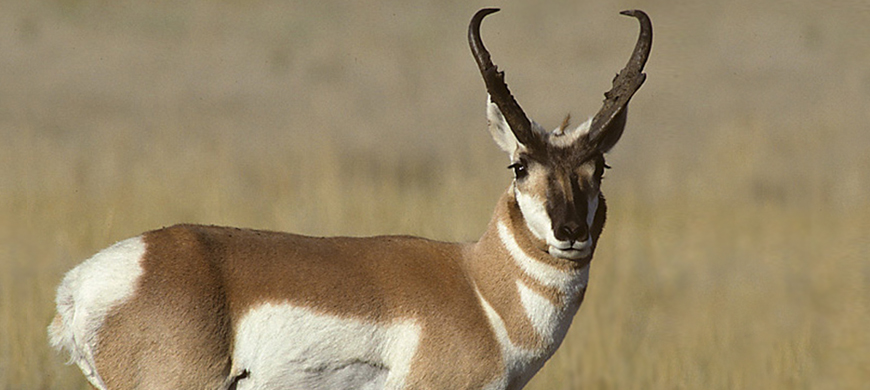
Antelope season; open season, bag limit and permits, statewide
If necessary, the Commission will reconvene at 9 a.m. at the same location, June 14, 2019, to complete any unfinished business. Should this occur, time will again be set aside for public comment on non-agenda items.
If notified in advance, the Commission will have an interpreter available for the hearing impaired. To request an interpreter, call the Kansas Commission for the Deaf and Hard of Hearing at 1-800-432-0698. Any individual with a disability may request other accommodations by contacting the Commission secretary at 620-672-5911.
The next KWPT Commission meeting is scheduled for Thursday, August 15 at the University of Kansas Edwards Campus, Best Conference Center, in Overland Park.
PRATT – Are you an award-winning photographer? You could be! Entries are being accepted for the 2019 “Wild About Kansas” photo contest hosted byKansas Wildlife and Parks Magazine. If you’ve taken a photo highlighting Kansas wildlife, outdoor recreation, hunting, fishing, or local landscapes, consider participating in the 7th annual contest by 11:59 p.m. on Oct. 11, 2019. Here’s how to enter.
1. Visit ksoutdoors.com, click “Publications,” then “2019 Wild About Kansas Photo Contest.”
2. Carefully read each category description, and contest rules.
3. Complete the “2019 ‘Wild About Kansas’ Entry Form” found at the bottom of the webpage. (You will receive a conformation code upon completion).
4. Copy your confirmation code into the subject line of a new e-mail.
5. Attach your photos, and detail which category each photo should be entered into (one category per image). E-mail your photos to [email protected].
Participants whose images have been selected for a 1st, 2nd, 3rd place or honorable mention award will have their winning imagery featured in the 2020 Jan/Feb photo issue of Kansas Wildlife and Parks Magazine.
PRATT – Kansas’ coveted nonresident deer permits are offered only through a limited draw lottery process, and this year’s drawing saw a record number of applicants: 24,024. Despite no changes to the total number of nonresident deer permits allocated by the Kansas Department of Wildlife, Parks and Tourism (KDWPT), there was an increase of 1,588 applicants over last year. Of the 24,024 hunters who applied, 88 percent were successful. No leftover permits will available this year.
The application period for the 2019 draw took place April 1-26. A total of 21,816 permits were then awarded through a random computer drawing, and applicants were notified of the results ¬¬– regardless of the outcome – beginning Friday, May 24.
The 2019 deer season will open Sept. 7-15 for youth and hunters with disabilities; Sept. 16-29 for muzzleloader season; Sept. 16-Dec. 31 for archery season; Oct. 12-14 for the pre-rut whitetail antlerless-only firearm season; and Dec. 4-15 for regular firearm seasons.
Extended firearm seasons will be open Jan.1-3 in Units 6, 8, 9, 10, and 17; Jan. 1-5 in Units 1, 2, 3, 4, 5, 7, 11, 14, and 16; and Jan. 1-12 in Units 10A, 12, 13, 15, and 19.
For more information on deer hunting in Kansas, visit ksoutdoors.com and click “Hunting,” “Big Game Information,” then “Deer.”
PRATT – The application deadline is June 14, 2019 for resident hunters wanting to apply for an elk, either-species/either-sex deer, or antelope permit. Earlier this year, the Kansas Wildlife, Parks and Tourism Commission voted in favor of moving the resident limited draw deer and elk permit application deadlines to the second Friday in June. This is the first year application deadlines for either-species/either-sex deer and elk permits will coincide with the firearm antelope application deadline.
Resident hunters can apply online at kshuntfishcamp.com. Fees are as follows:
ANTELOPE
General Resident: $62.50
Landowner/Tenant: $37.50
Youth (15 or younger): $22.50
Nonresident Tenant: $97.50
Preference point only: $11.50
DEER
Firearm (Either-species/Either-sex)
General Resident: $52.50
Landowner/Tenant: $32.50
Youth (15 or younger): $22.50
Preference point only: $11.50
ELK*
Firearm (Any Elk)
General Resident: $302.50
Landowner/Tenant: $152.50
Youth (15 or younger): $127.50
Nonresident Tenant: $152.50
Preference point only: $11.50
Antlerless
General Resident: $152.50
Landowner/Tenant: $77.50
Youth (15 or younger): $52.50
Nonresident Tenant: $77.50
Preference point only: $11.50
*Fee to apply for an elk permit, or purchase a bonus point, is $11.50. Permit fees are collected from successful applicants only.
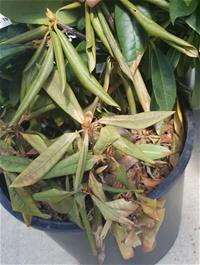
MANHATTAN — The Kansas Department of Agriculture’s plant protection and weed control program this week confirmed the presence of a plant disease in hundreds of rhododendrons sold at large retail stores in Kansas. Sudden Oak Death (SOD) is a plant disease that has killed large tracts of oaks and other native species in California and Oregon, and infected rhododendrons have been identified in 10 states in the Midwest, including Kansas. The infected plants that have been found in the Midwest have all been traced back to a common source.
The causal agent of SOD, Phytophthora ramorum, has been detected in rhododendrons originating from Park Hill Plants nursery in Oklahoma, and plants from that nursery were shipped to 60 Walmart stores across Kansas and one Home Depot store in Pittsburg, Kansas.
Those stores have cooperated with KDA, USDA, and other states’ plant regulatory staff as they work to destroy all infected and potentially-infected rhododendrons still for sale, along with any other host plants in the vicinity. There is no treatment for the pathogen or disease and infected plants should be destroyed to prevent spread.
Consumers who purchased rhododendrons and other known P. ramorum hosts in April, May or June of 2019 in varieties that have been determined to be infected should take action to dispose of the plants immediately to prevent further spread of the disease.
Plants can be destroyed by burning on site, deep burial, or by double bagging in heavy duty trash bags (including the root ball) and disposing into a sanitary landfill where permitted. Varieties that should be destroyed include: Cat Cunningham Blush, Firestorm, Holden, Nova Zembla, Percy Wiseman, Roseum Elegans, and Wojnars Purple.
Other varieties of rhododendrons and other plant species may be infected as well. There are over 100 known species susceptible to P. ramorum, including, trees, shrubs and herbaceous plants. Symptoms of SOD include foliar leaf spots, browning and wilting of leaves, and brown to black discoloration on stems and/or trunks. If you observe symptoms, or are uncertain of the variety of your rhododendron. please contact your local K-State Research and Extension office for assistance.
Sudden Oak Death has not shown to be a health risk to humans or animals, even if nuts, fruit, leaves or berries from an infected plant are eaten.
For photos of symptomatic plants, a list of extension offices, or other information about what you can do to help stop the spread of this plant disease, go to agriculture.ks.gov/SOD. For additional information about SOD, see www.suddenoakdeath.org.
 In the time I have spent in public service, I have been privileged to be a part of some important legislative changes and met some incredible people in the process.