We have a brand new updated website! Click here to check it out!

Senior Legion wins opener at Emporia tournament

EMPORIA – The Hays Eagles Senior American Legion scored early and often and got a strong pitching performance from Willie Sennett and blanked Wellington 12-0 in a game called after four innings by run-rule Friday on the opening day of the Sam Ellis Classic.

Cody Petersen drove in runs with a first inning triple and third inning double. He was the only Eagle with two hits. Willie Sennett and Jamison Martin also had two RBIs.

Sennett allowed only one hit over the four innings with four strikeouts and two walks and picked up the win.

The Eagles (5-2) continue play Saturday against the Topeka Senators and Newton.

Junior Legion goes 1-1 on first day of McPherson tournament

McPHERSON – The Hays Eagles Junior American Legion baseball team split their two games at the McPherson 16U Tournament. The Eagles lost 12-5 to the Wichita Aeros-Grillot but bounced back to beat Hutchinson 7-1 Friday at the Grant Sports Complex.

The Aeros scored 11 of their 12 runs in the first two innings while holding the Eagles to two hits.

Dawson VonFeldt walked seven and allowed 11 runs on six hits in his first start of the season.

Dalton Dale allowed one run on one hit for the win against Hutchinson. Dale walked six while striking out four in the game called after four innings because of time limit.

Noah Weimer and Mason Robbins both had two of the Eagles eight hits.

The Eagles (1-5-1) scored four in the first on a Remington Cox RBI double, a wild pitch, a throwing error and Jack Fields RBI double. They added a run in the second and two more in the fourth.

They begin bracket play Saturday morning against the Buhler Junior Nationals.

The Latest: Trump says tariffs on Mexico suspended indefinitely

WASHINGTON (AP) — President Donald Trump announced late Friday that he had suspended plans to impose tariffs on Mexico, tweeting that the country “has agreed to take strong measures” to stem the flow of Central American migrants into the United States. But the deal the two neighbors agreed to falls short of some of the dramatic overhauls the U.S. had pushed for.

A “U.S.-Mexico Joint Declaration” released by the State Department said the U.S. “will immediately expand the implementation” of a program that returns asylum-seekers who cross the southern border to Mexico while their claims are adjudicated. Mexico will “offer jobs, healthcare and education” to those people, the agreement stated.

Mexico has also agreed, it said, to take “unprecedented steps to increase enforcement to curb irregular migration,” including the deployment of the Mexican National Guard throughout the country, especially on its southern border with Guatemala. And Mexico is taking “decisive action to dismantle human smuggling and trafficking organizations as well as their illicit financial and transportation networks,” the State Department said.

The move puts to an end — for now — a threat that had sparked dire warnings from members of Trump’s own party, who warned the tariffs would damage the economy, drive up prices for consumers and imperil an updated North American trade pact. Trump’s Friday night tweet marked a sharp reversal from earlier in the day, when his spokeswoman Sarah Sanders told reporters: “Our position has not changed. The tariffs are going forward as of Monday.”

Mexican President Andrés Manuel López Obrador tweeted, “Thanks to the support of all Mexicans, the imposition of tariffs on Mexican products exported to the USA has been avoided.” He called for a gathering to celebrate in Tijuana Saturday.

The changes, in part, continue steps the Trump administration was already taking. The U.S. announced in December that it would make some asylum seekers wait in Mexico while their cases were being proceeded — a begrudging agreement with Mexico that has taken months to scale and that has been plagued with glitches, including wrong court dates, travel problems and issues with lawyers reaching their clients.

Homeland Security officials have been ramping up slowly, and were already working to spread the program along the border before the latest blowup. About 10,000 people have been returned to Mexico to wait out the processing of their immigration cases since the program began Jan. 29. More than 100,000 migrants are currently crossing the U.S. border each month, but not everyone claims asylum and migrants can wait an entire year before making a claim.

Any sizable increase may also be difficult to achieve. At the San Ysidro crossing alone, Mexico had been prepared to accept up to 120 asylum seekers per week, but for the first six weeks only 40 people per week were returned.

Trump had announced the tariff plan last week, declaring in a tweet that, on June 10, the U.S. would “impose a 5% Tariff on all goods coming into our Country from Mexico, until such time as illegal migrants coming through Mexico, and into our Country, STOP.” U.S. officials had laid out steps Mexico could take to prevent the tariffs, but many had doubts that even those steps would be enough to satisfy Trump on illegal immigration, a signature issue of his presidency and one that he sees as crucial to his 2020 re-election campaign.

After returning from Europe Friday, though, Trump tweeted, “I am pleased to inform you that The United States of America has reached a signed agreement with Mexico.” He wrote that the “Tariffs scheduled to be implemented by the U.S. on Monday, against Mexico, are hereby indefinitely suspended.”

He said Mexico has agreed to work to “stem the tide of Migration through Mexico, and to our Southern Border” and said those steps would “greatly reduce, or eliminate, Illegal Immigration coming from Mexico and into the United States.”

The 5% tax on all Mexican goods , which would increase every month up to 25% under Trump’s plan, would have had enormous economic implications for both countries. Americans bought $378 billion worth of Mexican imports last year, led by cars and auto parts. Many members of Trump’s Republican Party and business allies had urged him to reconsider — or at least postpone actually implementing the tariffs as talks continue — citing the potential harm to American consumers and manufactures.

From the moment Trump announced the tariff threat, observers wondered whether he would pull the trigger, noting his habit of creating problems and then claiming credit when he rushes in to solve them.

In late March, Trump threatened to shut the entire U.S.-Mexico border if Mexico didn’t immediately halt illegal immigration. Just a few days later, he backed off that threat, saying he was pleased with steps Mexico had taken. It was unclear, however, what — if anything — Mexico had changed.

U.S. and Mexican officials met for more than 10 hours Friday during a third day of talks at the U.S. State Department trying to hash out a deal that would satisfy Trump’s demand that Mexico dramatically increase its efforts to crack down on migrants.

The talks had been focused, in part, on attempting to reach a compromise on changes that would make it harder for migrants who pass through Mexico from other countries to claim asylum in the U.S., those monitoring the situation said. Mexico has long opposed such a change but appeared open to considering a potential compromise that could include exceptions or waivers for different types of cases. The joint declaration, however makes no mention of the issue.

Leaving the State Department Friday night, Mexican Foreign Secretary Marcelo Ebrard said he thought the deal struck “a fair balance” because the U.S. “had more drastic proposals and measures at the start.”

But Leticia Calderón Cheluis, a migration expert at the Mora Institute in Mexico City, said the agreement is essentially a series of compromises solely by Mexico, which she said committed to “a double clamp at both borders.”

Trump in recent months has embraced tariffs as a political tool he can use to force countries to comply with his demands — in this case on his signature issue of immigration. Beyond Trump and several White House advisers, though, few in his administration had believed the tariffs were a good idea, according to officials familiar with internal deliberations. Those people had worried about the negative economic consequences for Americans and argued that tariffs — which would likely spark retaliatory taxes on U.S. exports — would also hurt the administration politically.

Republicans in Congress had also warned the White House that they were ready to stand up to the president to try to block his tariffs, which they worried would spike costs to U.S. consumers, harm the economy and imperil a major pending U.S.-Mexico-Canada trade deal .

Senate Minority Leader Chuck Schumer, D-N.Y., greeted Friday night’s news with sarcasm. “This is an historic night!” he tweeted. “Now that that problem is solved, I’m sure we won’t be hearing any more about it in the future.”

___

WASHINGTON (AP) — President Donald Trump says he has suspended plans to impose tariffs on Mexico, tweeting that the country “has agreed to take strong measures” to stem the flow of Central American migrants into the United States.

“I am pleased to inform you that The United States of America has reached a signed agreement with Mexico,” Trump tweeted Friday night, saying the “Tariffs scheduled to be implemented by the U.S. on Monday, against Mexico, are hereby indefinitely suspended.”

He said Mexico has agreed to work to “stem the tide of Migration through Mexico, and to our Southern Border” and said those steps would “greatly reduce, or eliminate, Illegal Immigration coming from Mexico and into the United States.”

He said details would be released soon by the State Departemnt.

The tweet marked a change in tone from earlier Friday, when his spokeswoman Sarah Sanders told reporters in Ireland before Trump took off: “Our position has not changed. The tariffs are going forward as of Monday.” Trump has often said unpredictability helps him negotiate.

A tax on all Mexican goods , which would increase every month up to 25% under Trump’s plan, would have had enormous economic implications for both countries. Americans bought $378 billion worth of Mexican imports last year, led by cars and auto parts. Many members of Trump’s Republican Party and business allies have urged him to reconsider — or at least postpone actually implementing the tariffs as talks continue — citing the potential harm to American consumers and manufactures.

U.S. and Mexican officials held a third day of talks at the U.S. State Department trying to hash out a deal that would satisfy Trump’s demand that Mexico dramatically increase its efforts to crack down on migrants.

The talks were said to be focused, in part, on attempting to reach a compromise on changes that would make it harder for migrants who pass through Mexico from other countries to claim asylum in the U.S., those monitoring the situation said. Mexico has opposed such a change but appeared open to considering a potential compromise that could include exceptions or waivers for different types of cases.

Trump has nonetheless embraced tariffs as a political tool he can use to force countries to comply with his demands — in this case on his signature issue of immigration. And he appeared poised earlier Friday to invoke an emergency declaration that would allow him to put the tariffs into effect if that is his final decision, according to people monitoring the talks.

“If negotiations continue to go well,” Trump “can turn that off at some point over the weekend,” Marc Short, Vice President Mike Pence’s chief of staff, told reporters.

Talks had gotten off to a shaky start Wednesday, as the U.S. once again pressed Mexico to step up enforcement on its southern border with Guatemala and to enter into a “safe third country agreement” overhauling its asylum system. But as talks progressed Thursday, U.S. officials began to grow more optimistic, with Short reporting Mexican “receptivity” to potential asylum changes.

Still, he said there was “a long way to go in that particular piece.”

In Mexico, President Andrés Manuel López Obrador would not say whether he would accept his country agreeing to be a “safe third country.”

“That is being looked at,” he said Friday morning during his daily news conference, where he held out hope a deal could be reached before Monday’s deadline.

In addition, Mexican Foreign Secretary Marcelo Ebrard said Thursday his country had agreed to deploy 6,000 National Guard troops to its border with Guatemala to help control the flow of migrants as part of its concessions.

He tweeted late Friday that there would be no “tariff application on Monday.”

“Thanks to all the people who have supported us by realizing the greatness of Mexico,” he wrote.

Beyond Trump and several White House advisers, few in his administration believe the tariffs are a good idea, according to officials familiar with internal deliberations. Those people worry about the negative economic consequences for Americans and believe the tariffs — which would likely spark retaliatory taxes on U.S. exports — would also hurt the administration politically.

Republicans in Congress have warned the White House that they are ready to stand up to the president to try to block his tariffs, which they worry would spike costs to U.S. consumers, harm the economy and imperil a major pending U.S.-Mexico-Canada trade deal .

New Kansas trial ordered in 2008 death of insect exterminator

TOPEKA, Kan. (AP) — The Kansas Supreme Court has unanimously overturned the conviction of a man who killed an insect exterminator in February 2008.

Howard Barrett photo KDOC

The court ruled Friday the case against 61-year-old Howard Barrett should be returned to Riley County for a new trial.  Read the ruling here.

Barrett beat and fatally stabbed 48-year-old Thomas James, who was doing extermination work in Barrett’s apartment in Leonardville.

His attorney argued that Barrett, who is schizophrenic, felt irrationally threatened by James.

Barrett was convicted in November 2014 of second-degree murder but appealed, saying jurors should have been instructed they could find him guilty of imperfect self-defense voluntary manslaughter.

The Court of Appeals ruled that error was harmless because Barrett’s second-degree murder conviction nullified a possible manslaughter conviction.

The Supreme Court disagreed, saying the jury could have reasonably convicted Barrett of manslaughter.


Kansas man hospitalized after pickup rear-ends semi

GOVE COUNTY — One person was injured in an accident just before 1:30p.m. Friday in Gove County.

The Kansas Highway Patrol reported a 2014 Dodge Ram driven by Cory S. Romanowksi, 25, Phillipsburg, was northbound on Gove County Road 30 four miles south of Grinnell.

The pickup rear-ended a 2018 Peterbilt semi driven by Daniel I. Weis, 36, Grainfield, that was slowing to turn east onto Gove County Road Z.

Romanowski was transported to Gove County Medical Center. Weis was not injured. Both drivers were properly restrained at the time of the accident, according to the KHP.

New Secretary of Dept. of Administration announced

Dr. DeAngela Burns-Wallace
OFFICE OF GOV.

TOPEKA – Governor Laura Kelly announced today DeAngela Burns-Wallace as her choice to lead the Kansas Department of Administration.

“I’m pleased to have DeAngela Burns-Wallace on board to lead the Department of Administration,” Kelly said. “Her extensive experience and diverse qualifications will be vital to this agency. I look forward to continuing our efforts to increase transparency of contracts and improve state government.”

Burns-Wallace currently is the Vice Provost of Undergraduate Studies at the University of Kansas. Previously, Burns-Wallace was Assistant Vice Provost for Undergraduate Studies at the University of Missouri. She also served as fellow at the American Council on Education in Washington, D.C., for an emerging Leaders Fellowship in 2013. She earned her B.A. in International Relations from Stanford University, her M.P.A in Public Policy & International Affairs from Princeton University and a doctorate in Higher Education Management from the University of Pennsylvania.

“I am honored to be selected by Governor Kelly to serve the people of Kansas as Secretary of the Department of Administration,” Burns-Wallace said. “I look forward to working alongside her team to build on the progress of the last five months. Kansans are depending on us to work on their behalf.”

Current Acting Secretary Duane Goossen will step down June 7, 2019. Goossen was secretary of administration for Governors Sebelius, Parkinson and Kelly, and budget director for Governors Graves, Sebelius, and Parkinson. He also worked on the Kelly Transition Team.

“Duane was an integral part of our efforts to rebuild our state and improve morale among state employees,” Kelly said. “I can’t emphasize how important he was to this agency, as well as the state as a whole. I thank him for his friendship and service to the state of Kansas.”

John Yeary, currently with the agency, will operate as acting secretary starting June 7 until Burns-Wallace becomes acting secretary on July 1.

Burns-Wallace is to be submitted to the Senate Confirmation Oversight Committee during interim and voted on by the full Senate in 2020.

Court lifts injunction blocking Keystone XL oil pipeline

HELENA, Mont. (AP) — An appeals court has lifted a judge’s injunction that blocked construction of the Keystone XL oil pipeline from Canada to the U.S., but the developer has said it’s too late to begin work this year and environmental groups vowed to keep fighting it.

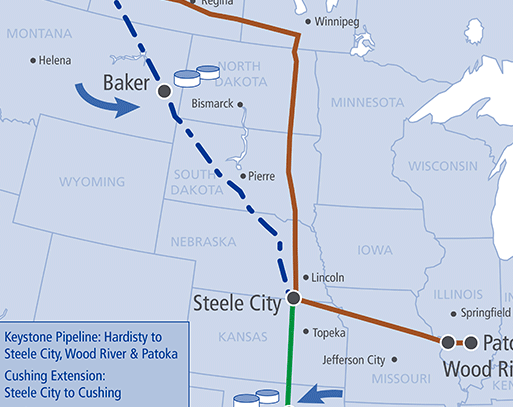
Keystone XL Pipeline — Overall route map courtesy Trans Canada

A three-judge panel of the 9th U.S. Circuit Court of Appeals on Thursday ordered dismissal of the lawsuit by environmental and Native American groups, saying President Donald Trump had revoked a 2017 permit allowing the $8 billion pipeline to be built.

Trump later issued a new permit, and the appellate judges agreed with Justice Department attorneys who say that nullifies the legal challenge involving environmental impacts.

The pipeline would ship up to 830,000 barrels (35 million gallons) of crude oil daily from the tar sands of Alberta through Montana, South Dakota and Nebraska, where it would tie in to existing pipelines to carry the crude to U.S. refineries.

The ruling Thursday was a victory for TC Energy, a Calgary, Alberta-based company that wants to build the line, though company officials have said it already missed the 2019 construction season because of court delays.

“We are pleased with the ruling,” TC Energy spokesman Matthew John said. “We look forward to advancing the project.”

John did not respond to questions on whether the ruling would change the construction schedule.

Attorneys for the plaintiffs accuse Trump of trying to get around court rulings by issuing the new permit, which they say also is flawed. They have filed another, ongoing lawsuit to block the new presidential permit.

Attorney Stephan Volker, who represents the Indigenous Environmental Network and North Coast Rivers Alliance, said he would request another judge’s order to block the project if he thought there was a chance of construction beginning immediately.

Representatives of a half-dozen other environmental groups vowed to keep fighting in court and predicted the pipeline will never be built.

“We shouldn’t forget the underlying issue here — global warning,” Volker said. “We’re trying to save the Earth. I wish the federal government would pay attention to the science and do its job.”

Last fall, U.S. District Judge Brian Morris in Montana ruled that the Trump administration did not fully consider potential oil spills and other environmental effects when it issued the 2017 permit. He blocked construction by issuing a permanent injunction against the project.

White House officials contend a presidential permit can’t be reviewed by a court. After Trump revoked that permit and issued and signed the new one, Justice Department attorneys argued that claims in that lawsuit — and Morris’ injunction — no longer applied.

The environmental groups argued that the government can’t unilaterally sweep aside years of litigation against the long-stalled pipeline.

The Justice Department has not yet responded to the second lawsuit.

Kelly sends right-hand man to hear out rural towns on economy, housing and more

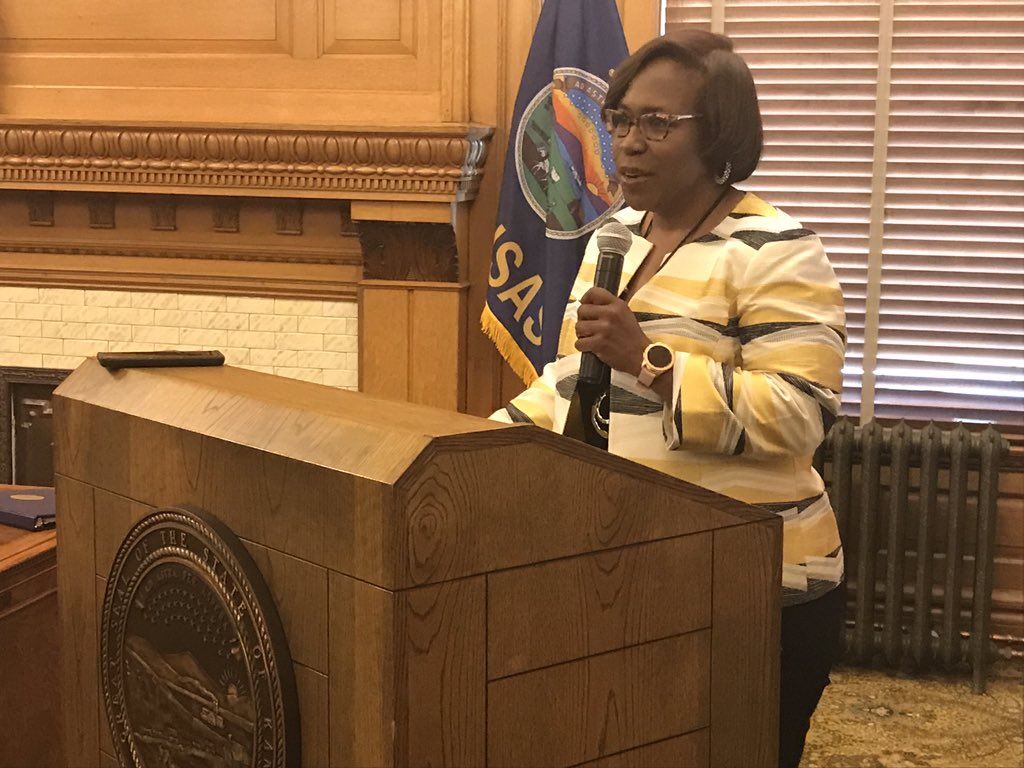
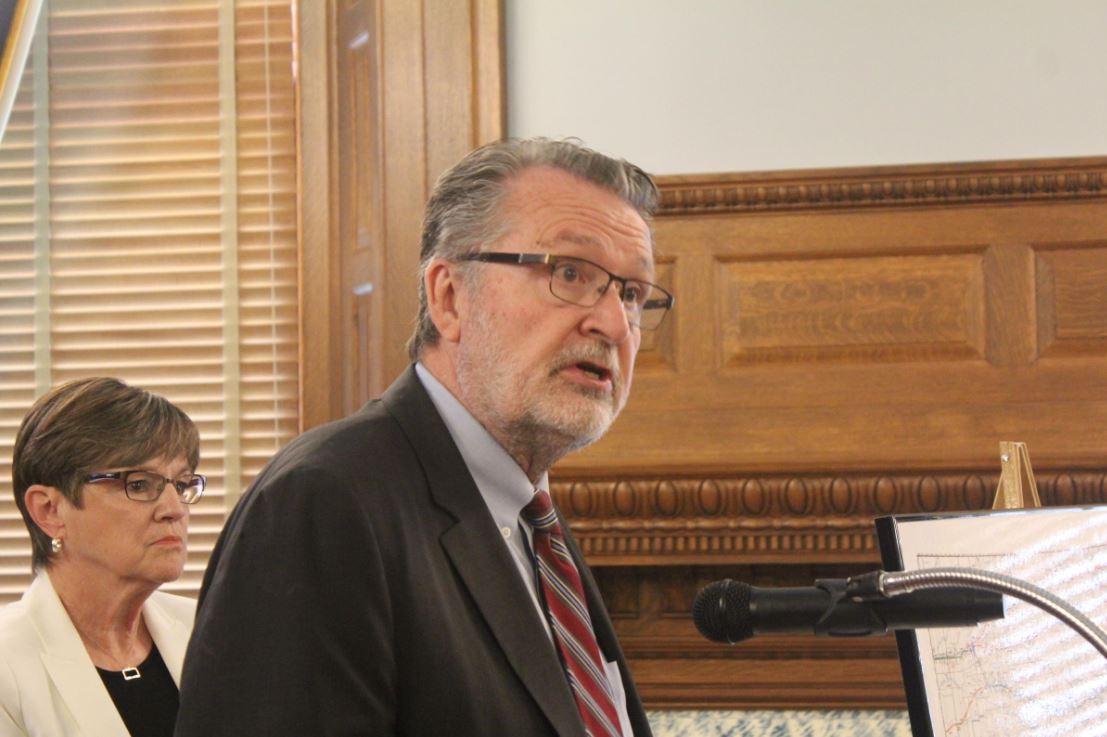
Lt. Gov. Lynn Rogers and Gov. Laura Kelly at a Wednesday press conference announcing a tour of rural communities. (Photo by Jim McLean/Kansas News Service)

KANSAS NEWS SERVICE

TOPEKA – Lt. Gov. Lynn Rogers will spend 12 days this summer in 12 far-flung towns in what is clearly an effort to show the governor’s office cares about rural challenges.

Rogers will be in Colby June 24 and Phillipsburg June 25.

He’ll hear about pains that can seem counterintuitive: Housing shortages on the wide-open prairie, for one. Or the fact that growing communities with plenty of work-age folks can struggle to train up local health workers, even while thousands toil there at lower-paying jobs.

Rural towns are used to politicians promising help or taking piecemeal stabs at fixing things. With a fresh rural revitalization effort in the Legislature and Rogers’ upcoming tour, could bigger solutions materialize? Read about the tour.

Barton Co. student elected alternate Boys Nation senator

MANHATTAN – Two delegates from the 2019 session of the American Legion Boys State of Kansas Leadership Academy have been elected by their peers to represent Boys State of Kansas as senators at Boys Nation this summer.

Ian Gould, a resident of Roeland Park, Kan., and a senior-to-be at Shawnee Mission East High School in Prairie Village, Kan., and Zachary Wash, a resident of McPherson, Kan., and a senior to be at McPherson High School, will attend Boys Nation, Friday, July 19 through Saturday, July 27, at Marymount University in Arlington, Va. The announcement was made this afternoon during the ALBSKLA’s closing ceremonies at Kansas State University in Manhattan.

Benjamin Brake, Wichita, Kan., Wichita Collegiate School, and Gabe Wolff, Pawnee Rock, Kan., Macksville (Kan.) High School in Barton County, were selected as first alternate and second alternate, respectively.

At Boys Nation, Gould and Wash will join representatives from each of the 49 Boys State programs across the country (Hawaii does not have a Boys State program) to receive an education on the structure and function of federal government. At the event, each delegate acts as a senator from his Boys State. The young lawmakers caucus at the beginning of the session, then organize into committees and conduct hearings on bills submitted by program delegates. Senators learn the proper method of handling bills, according to U.S. Senate rules. Participation in the political process is emphasized throughout the week, including organization of party conventions, and nominating and electing a president and vice president.

The week of government training also includes lectures, forums and visits to federal agencies, national shrines, institutions, memorials and historical sites. On Capitol Hill, Boys Nation senators meet with elected officials from their home states.

Approximately 405 young men from across the State of Kansas, all of whom will enter their senior year of high school this fall, participated in the 2019 session of the American Legion Boys State of Kansas Leadership Academy. The event, which completed its 82nd year, started June 3 and concluded today.

The ALBSKLA provides a relevant, interactive, problem-solving experience in leadership and teamwork that develops self-identity, promotes mutual respect and instills civic responsibility. Boys State is a “learning by doing” political exercise that simulates elections, political parties and government at the state, county and local levels, providing opportunities to lead under pressure, showcasing character and working effectively within a team. It’s also an opportunity to gain pride and respect for government and the price paid by members of the military to preserve democracy.

– SUBMITTED –

Kan. Supreme Court affirms conviction in killing of Salina girl

TOPEKA —The Kansas Supreme Court has affirmed Macio Domingo Palacio, Jr.’s convictions in Saline County District Court in the death of Allie Saum in May of 2015, according to a media release from the court.

Palacio photo KDOC

He is one of five men convicted in the fatal shooting of the 17-year-old Salina girl.

In a decision written by Justice Eric Rosen and published Friday, the Supreme Court affirmed Palacio’s Saline County District Court convictions for first-degree murder, attempted first-degree murder, criminal discharge of a firearm at an occupied vehicle, and conspiracy to commit aggravated battery.

The court held that the district court did not err in denying Palacio’s motion to change venue.

It also rejected Palacio’s claim that the district court erred in denying his motion to suppress his confession. Palacio had argued that investigators obtained his confession in violation of his constitutional rights by interrogating him after he clearly asked to speak with a lawyer and by exerting coercive tactics. The court held that the officers’ questions did not constitute interrogation and that Palacio’s confession was voluntary.

ARC Park in Hays receives $5,000 donation from Cenex

Accessibility-focused park honored for meaningful contributions to Kansas community

The Accessible Recreation Complex (ARC Park) that is being constructed in Hays was recognized by Robcom LLC and Cenex, the energy brand of CHS, for being a unique source of pride in the community. ARC Park is an accessible play space for children of all abilities that is set to open this fall.

 The Arc of Central Plains received a $5,000 donation to help fund construction of the park.

Once completed, ARC Park will provide children of western Kansas with a fully accessible playground, baseball field and splash pad where those of all abilities can play together. The space will emphasize inclusion, self-empowerment, collaboration and imaginative play for the 1,400 children and adults with disabilities in the area, along with their families and friends.

 “Southside Convenience is proud to support our community,” said Tara Patel, owner of the Southside Convenience Cenex location in Hays. “ARC Park will be a tremendous asset to the city of Hays and to the thousands of children who will play there each year.”

 The $5,000 donation was provided to Southside Convenience through a grant program that encourages Cenex retailers to share stories about what makes their local communities unique or special. In total, Cenex retailers will receive more than $100,000 to give back to their communities this year. 

 “The Cenex brand has a deep-rooted history of serving the people and communities of rural America,” says Bryan Brignac, director of marketing at CHS, the nation’s largest farmer-owned cooperative. “We are proud of our Cenex retailers, like Southside Convenience, who play an active role in enriching their communities.”

Applications for the grants are competitive among almost 1,500 stores in 19 states.

“The ARC Park has a unique opportunity to be the pride of western Kansas,” Brignac said. “we are supportive of any meaningful projects that will help enrich the lives for so many different families and kids in the Hays area. When you look nationally, how many of these parks are out there?

“This, in our eyes, is a very unique attraction that will definitely benefit not only the residents of Hays, but people from the surrounding communities. With an impact like that, we definitely thought it was unique and deserving of a community contribution.”

Cenex, the energy brand of CHS, provides high-quality refined fuels through nearly 1,500 locally-owned convenience store locations across 19 states. CHS owns and operated the refinery in McPherson, Kansas, where 800 people are employed. CHS buys the majority of its fuel that is processed at McPherson from framers and ranchers in the Kansas area, Brignac said.

Consumers depend on Cenex fuels, lubricants, propane and renewable energy products to power homes, businesses and communities. CHS, Inc.(www.chsinc.com), which owns the Cenex brand, is a leading global agribusiness owned by American farmers across the United States with domestic and international operations including energy, agronomy, grain trading and food processing.

Prosecutor ends criminal investigation of Chiefs’ Tyreek Hill

OLATHE, Kan. (AP) — A prosecutor says he is no longer actively investigating a criminal case against Kansas City Chiefs wide receiver Tyreek Hill involving alleged injuries to his 3-year-old son.

Tyreek Hill -photo courtesy KC Chiefs

Johnson County Attorney Steve Howe told The Kansas City Star he would reconsider his decision if new evidence emerges against Hill, who has been suspended from the team since April 25 after a television station aired a recording of a conversation between Hill and his fiancee, Crystal Espinal, about the boy’s treatment.

In news conference a day earlier, Howe said he believed the boy had been hurt but would not file charges because he couldn’t prove who did it.

The Kansas Department for Children and Families continues to investigate the couple after police were called to the Hill’s home twice in March.

Hill has maintained his innocence. Chiefs spokesman Ted Crews declined comment Friday.

Copyright Eagle Radio | FCC Public Files | EEO Public File