We have a brand new updated website! Click here to check it out!

🎥 Large crowd shows opposition to 37th Street extension proposal

Members of the Hays 37th Street Association applaud following Daniel LaBarge’s presentation to the Hays City Commission Thursday. The group opposes the proposed extension of 37th west of Vine Street as part of the traffic roundabouts project.

By BECKY KISER
Hays Post

Despite the opposition shown by a standing-room only crowd at Thursday night’s Hays City Commission meeting, homeowners in northwest Hays were unable to convince a majority of commissioners to change their minds about the planned extension of West 37th Street.

As part of the $9.3 million project to build four traffic roundabouts on north Vine Street, West 37th would be extended to the west from Vine and West 41st would be realigned to meet that extension. A new public street would be constructed south of the new intersection to maintain access to the existing gas station south of West 37th.

Four traffic roundabouts are to be constructed on Vine Street/U.S. Highway 183 at 32nd/33rd, 37th, 41st Streets, and a partial roundabout at the eastbound exit ramp of Interstate 70.

Representing the Hays 37th Street Association, homeowner Ryan Rymer said the group’s chief concern is keeping the neighborhood safe from increased traffic.

Ryan Rymer of the Hays 37th Street Association addresses the commission.

“It’s one in which you can raise a family, where the hustle and bustle of Vine Street is distant, the concerns of through-passing criminals are few, crime occurrence is low, homes are affordable, and they are not likely to flood. The potential of a connection to Vine Street negates all the reasons why we chose this area,” Rymer told the commission.

Stop signs at 37th and Fort and 35th and Fort were recently changed at those intersections to now stop east/west bound traffic. The switch was made at the suggestion of City Commissioner Sandy Jacobs, who lives on 38th, as a compromise within the proposal.

“I think their concerns about traffic going through their [neighborhood] quickly can be waylaid if [traffic on 37th] has to stop at Willow, then they have to stop at Fort, then they have to stop at Skyline,” she said last week.

Jacobs told the Hays 37th Street Association on Thursday she still supports the street extension as part of the North Vine Street Corridor Improvement Project.

“I’ve been fact finding. I’ve done a lot of soul searching. I’ve driven up and down those streets,” Jacobs said. “I trust the city staff and I trust our engineers and I trust the people that are bringing these plans before us and recommend to us what is the best.”

Ryan Rymer presents a petition with more than 100 signatures to Hays Mayor Henry Schwaller.

Before he spoke, Rymer presented a petition with signatures of more than 100 residents opposed to the street extension.

The discussion started with a review of the 37th/Skyline/41st configuration by City Project Manager John Braun who explained the city has three basic options: Close 41st Street, reroute 41st between Phillips 66 gas station and the Baymont Inn, or connect 37th at Skyline.

The 37th/Skyline connection is favored by the city and “this has been the desired connection to Vine Street since the 2012 Comprehensive Plan,” according to Braun.

“The problem on the Vine Street corridor is the frontage roads. They do need to be disconnected or set back further from Vine. The situation will only get worse [with the installation of roundabouts] and it’s something we do need to address,” he said.

Daniel LaBarge

Another of the residents’ representatives, Daniel LaBarge, and the commission both agreed during the meeting the number one goal is to connect 41st Street. The presentations by LaBarge and Rymer drew applause from the audience. Several other people also spoke against the proposed plan, also mentioning possible drops in property values.

The city and its engineering firm WSP first considered an initial concept of disconnecting the frontage roads and reconnecting 41st between Phillips 66 and Baymont Inn.

“This design was initially pursued due to the uncertainty of [the status of] the former Ambassador Hotel property,” said Braun. “Upon further examination, this option proved to be undesirable.”

Braun explained why the first two options were discarded, outlining the pros and cons of each scenario.

Closing 41st Street would cost between $890,000 and $1.5 million – the least expensive construction cost among the three options – while isolating and disconnecting existing businesses and also hinder future property development. It would also push more traffic to 32nd and 33rd Streets.

Rerouting 41st between the gas station and motel is the most direct reconnection of 41st to Vine. It would cost approximately $1.8 million. It has a narrow right-of-way and would require more property be taken from nearby businesses. The gas station fuel tanks and canopy would have to be relocated. “There’s a higher probability for congestion in that area,” Braun noted.

Vice-Mayor Shaun Musil opposes the 37th Street extension to Skyline.

“I’ve said from day one, and I know I’m odd man out here, that I thought this is a bad idea. I see no gain. If there was a gain for my community, I’d be 100 percent for this,” he said.

Musil made a motion to support the second option of rerouting 41st between Phillips 66 and Baymont Inn. The motion died for lack of a second.

The pros and cons of extending 37th Street west of Vine and connecting at Skyline, according to Hays Project Manager John Braun.

Knowing all the drawbacks of the other options, the commission earlier decided on moving forward with the 37th and Skyline option, according to Braun.

The cost is estimated at $1.6 million and is in line with the Comprehensive Plan.

“This allows for the best traffic flow, facilitates future development of adjacent properties and does not impact existing businesses. It does allow convenient access to Vine from residential neighborhoods, limits the right of way acquisition to vacant properties and there’s no taking of active business properties. And there’s less utility conflicts with this option.”

Many residents in the affected neighborhoods have been in contact with Braun, other city staff and the city commissioners the past few weeks.

Braun talked about some of their questions, pointing out that 37th would not become an arterial thoroughfare or be widened but “simply provide access to Vine and parking would not be removed.”

Braun said Skyline can and does handle two-way traffic “just fine now and will continue to do so in the future.” That statement drew chuckles of disagreement from the audience.

Traffic will likely increase on 37th, Braun acknowledged, but “it will not be significantly more. Most people will continue using 33rd and 41st Streets as they do now.” Signs prohibiting truck traffic would also be posted.

Newly appointed commissioner Eber Phelps, who has served two previous terms, recalled previous street projects on 17th and 27th where residents feared would increase traffic accidents, but did not.

“[This is] almost like déjà vu,” Phelps said.

Many residents on 32nd and 33rd Streets have been in contact with Commissioner Ron Mellick, he told the audience.

“Many people on 34th, 35th, 36th, 37th, and 38th use 32nd and 33rd to access Vine now. … The only thing they’re asking is residents on 37th help shoulder and share a little of the traffic load,” Mellick said.

Mayor Henry Schwaller told the association he empathizes with them.

“The fear of the unknown is huge,” he said. “It’s possible that all those things [you’ve expressed concern about] could happen, but the probability is low. And I do admit there are some problems. But there really no clear alternatives that will benefit everyone. … We will do our best to configure this in a way that’s safe.

“Yes, there are some things we didn’t address. Those are speculations. We don’t know.”

When the North Vine Street improvement project design first began, Schwaller said he asked “why are we connecting this neighborhood to Vine Street?”

A portion of the engineering contract for the Vine Street traffic roundabouts includes extension of 37th Street to the west. (Click to enlarge)

“The reason wasn’t just because of 41st. The thought by staff and other city commissioners was that you’d like to go to Vine Street,” he told the 37th Street area residents. “That would be beneficial…now you won’t have to go down to 32nd and 33rd, and go through two roundabouts. Now you’ll just have one. I’m not defending it. I’m just telling you the discussion that was had at the time.”

Schwaller has previously said he opposes the current traffic roundabout plan and has voted against related agenda items.

“It was thought the neighborhood would like access to Vine Street in a more efficient way and it is not [purposely designed] to let more people into your neighborhood. Might that happen? Yes. I don’t think it will happen as often as you believe it will.”

Schwaller also noted the plan allows for quicker access north of town, including to the Highway 183 Bypass and the Ellis County landfill.

By the end of next week, 60 percent of the corridor design will be complete, Braun reported. Final plans are due by Dec. 9 with construction expected to start in the summer of 2020.

The proposed $9.3 million project would be funded by a $6 million federal grant and a dedicated 20-year 2 percent increase in the transient guest tax.

Kansas is already soggy and it’s about to get drenched — maybe dangerously so

Overflowing rivers and reservoirs across Kansas are already producing significant flooding, particularly in the southeast corner of the state.

But, forecasters say, things could get much worse over the next several days as slow-moving thunderstorms develop over central and northeast Kansas.

The storms, he said, could produce flooding in northeast Kansas similar to that generated by up to 20 inches of rain that fell over portions of southeast Kansas in recent days, sending the Neosho, Verdigris and Marmaton rivers over their banks.

That’s well above the region’s average rainfall for the entire month of May of about five inches.

“Many of these areas are seeing an entire month’s worth of rain in one night,” Omitt said.

Omitt joined Kansas Gov. Laura Kelly and the heads of several state agencies Thursday to brief reporters on disaster relief efforts already underway and warn that more creeks, rivers and reservoirs could soon be spilling over their banks.

“We’ve got to be vigilant, we’ve got to make safety a priority,” Kelly said, noting that she has issued disaster declarations for 42 of the state’s 105 counties since the end of April.

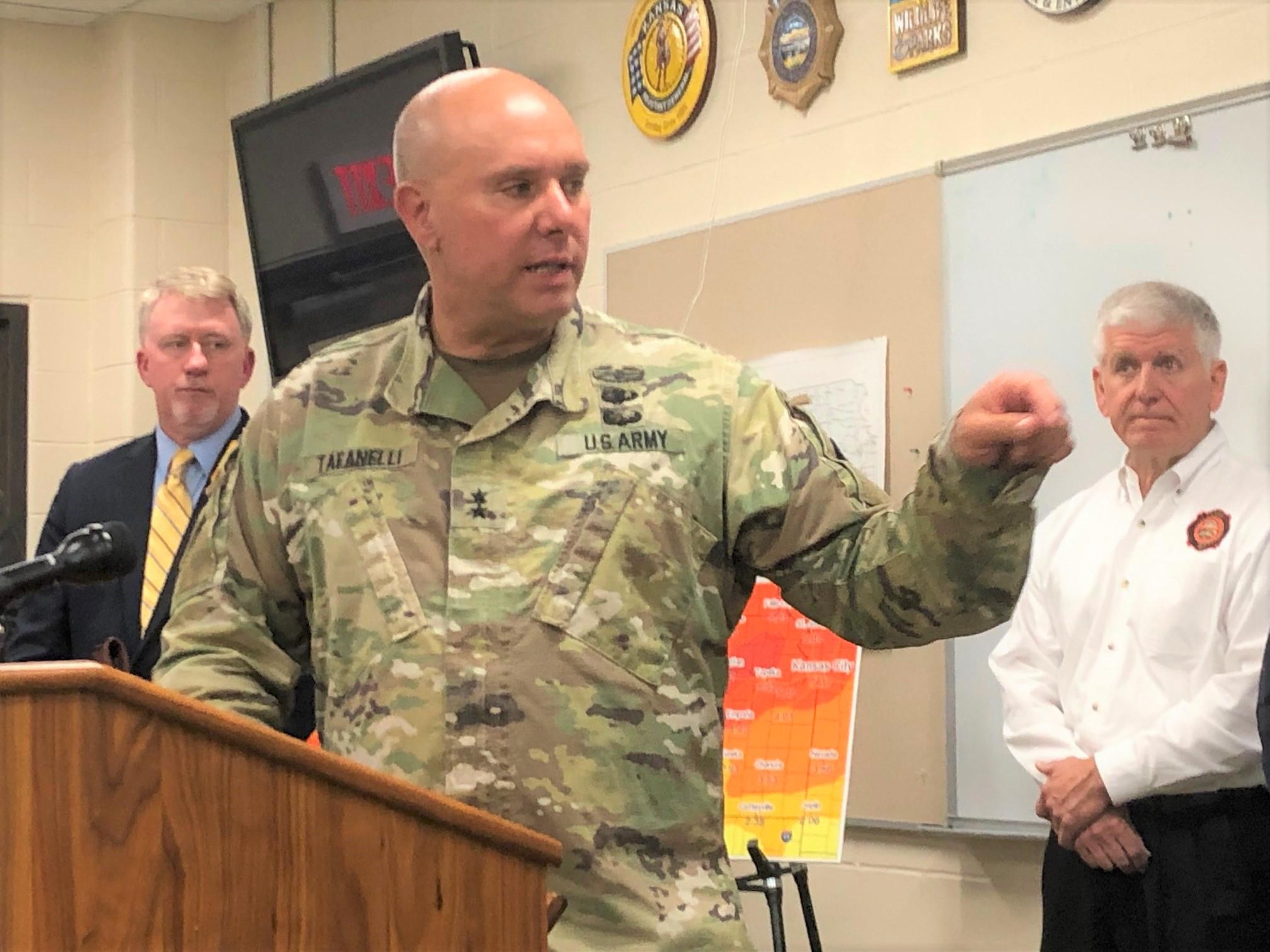
Maj. Gen. Lee Tafanelli, the commander of the Kansas National Guard and the state’s emergency management director, said Kansans should prepare for what he calls “a multi-hazard event” – meaning more heavy rain and the increased possibility of tornadoes and other types of severe weather.

Maj. Gen. Lee Tafanelli of the Kansas National Guard warns about possible flooding on the way in the state.
CREDIT JIM MCLEAN / KANSAS NEWS SERVICE

“It really creates a very dangerous situation,” Tafanelli said.

At a minimum, Tafanelli said, Kansans should factor the warnings into their plans for the Memorial Day weekend. That starts, he said, with checking to see whether rains have forced the closure of roads or state parks.

The recent death of a motorist who drove into water rushing over a roadway near Emporia should serve as a warning to all travelers, said Larry Thompson of the Kansas Department of Transportation.

“We’re urging drivers to pay attention when they’re out there,” Thompson said. “Don’t drive into flowing water, don’t drive around the barricades.”
Drivers who spot water overtopping a roadway, Thompson said, should call 911 to report it.

The Kansas Department of Children and Families is overseeing shelters for Kansans forced out of their homes by flooding, The Department of Health and Environment is preparing for possible weather-related health threats. In particular, heavy rain and flooding could sharply increase the number of disease-carrying insects.

“With water everywhere and warm temperatures, we will see ticks and mosquitos flourish,” said KDHE Secretary Lee Norman.

“So, once the water starts receding, it will be really important for people to drain out any standing water,” he said.

The forecast for continued heavy rain and severe weather runs through early next week, Omitt said.

“Probably through about Tuesday before the pattern breaks down,” he said, “we get this stuff to start moving and get we get some drier weather.”

Jim McLean is the senior correspondent for the Kansas News Service. You can reach him on Twitter @jmcleanks or email jim (at) kcur (dot) org.

FHSU student gets backup from senator on rescuing lost toddler

Photo credit: Jack Kelly, Josh Martinez

Hays Post

A potentially tragic moment was averted at about noon Friday when a Fort Hays State University student helped a toddler find her way home.

Holly Sieving said she was traveling on 13th Street at the intersection of Allen when she saw a “not-even-3-year-old” accompanied only by a dog and running into the street.

The toddler was running in and out of the street oblivious to oncoming traffic at the busy intersection, she said.

“Holly Sieving put herself in harm’s way to save an infant life,” said Josh Martinez, her co-worker at KVC Wheatland. “(The) infant was walking down 13th about to walk into a heavily trafficked road.”

Sieving parked her car crossways in the street to block traffic, called the police and she and Martinez went to rescue the child.

A truck also stopped and two men joined in the effort.

“I just started running after the girl … and she kept running,” she said. “The dog kept trying to bite me. “The gentlemen were trying to keep the dog off me.”

About seven minutes later, Sieving said she was able to coax the girl close enough to pick her up, while the two men followed the dog in hopes of it leading to the child’s home.

Around the same time, police arrived as well as a “panicked” father.

The girl was then safely returned to her father.

“I had no clue who the gentlemen were,” she said. “I shook their hands and asked their names.”

“Jerry Moran,” one said.

It took a moment to register, she laughed.

“Who are you again?” she said.

“United States Senator Jerry Moran,” she said he replied.

“We just kind of debriefed. It was a really traumatic thing to go through for anyone,” she said, admitting she was a little “starstruck.”

“All four of us .. helping someone who was more vulnerable than us … that child just needed help,” she said.

Sieving is a native of Silver Springs, Nev., who has lived in Hays for about five years.

“Together, Ms. Sieving and U.S. Sen. Moran, located the baby’s dwelling as well as notified authorities,” Martinez said. “This just goes to show that you can be a politician as well as a good human being.”

Hays Police Chief Don Scheibler later confirmed the 2-year-old has safely returned to her family at their residence on the 1400 block of Milner and the department’s investigation has concluded.

Trump sending troops to Middle East amid Iran tensions

WASHINGTON (AP) — The U.S. will bolster its military presence in the Middle East with an additional 1,500 troops, President Donald Trump said Friday amid heightened tensions with Iran.

Trump said the troops would have a “mostly protective” role as part of a build-up that began this month in response to what the U.S said was a threat from Iran without providing details or evidence.

“We are going to be sending a relatively small number of troops, mostly protective,” the president told reporters at the White House before setting off on a trip to Japan. “Some very talented people are going to the Middle East right now and we’ll see what happens.”

Trump has in recent weeks alternated between tough talk toward Iran and a more conciliatory message, insisting he is open to negotiations with the Islamic Republic. He seemed to downplay the prospect of conflict when he spoke at the White House.

“Right now, I don’t think Iran wants to fight and I certainly don’t think they want to fight with us,” he said.

The administration notified Congress earlier in the day about the troop plans.

The forces would number “roughly” 1,500 and would deploy in the coming weeks, “with their primary responsibilities and activities being defensive in nature,” according to a copy of the notification obtained by The Associated Press.

Their mission would include protecting U.S. forces already in the region and ensuring freedom of navigation, the notification said.

Earlier this week, officials said Pentagon planners had outlined proposals that could have sent up to 10,000 military reinforcements to the region. Acting Defense Secretary Patrick Shanahan later said planners hadn’t settled on a figure.

The U.S. has tens of thousands of troops in the Middle East, including at a major Navy base in Bahrain and an Air Force base and operations center in Qatar. There are about 5,200 troops in Iraq and 2,000 in Syria.

Earlier this month, the U.S. sent thousands more into the region around Iran, including an aircraft carrier strike group, four bomber aircraft and fighter jets in response to the unspecified threat.

Tension had been rising with Iran for more than a year. The Trump administration withdrew last year from the 2015 nuclear deal between the Islamic Republic and world powers and reinstated American sanctions that have badly damaged the Iranian economy.

The president has argued that the nuclear deal failed to sufficiently curb Iran’s ability to develop nuclear weapons or halt its support for militias throughout the Middle East that the U.S. argues destabilize the region.

Missouri governor signs bill banning abortions at 8 weeks

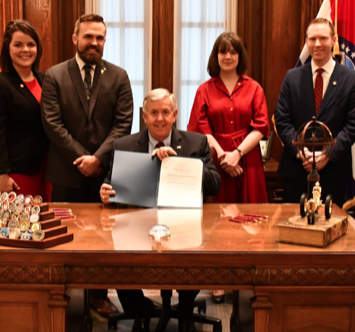
JEFFERSON CITY, Mo. (AP) — Missouri Gov. Mike Parson on Friday signed a bill that bans abortions on or beyond the eighth week of pregnancy without exceptions for cases of rape or incest, making it among the most restrictive abortion policies in the nation.

Friday signing ceremony photo courtesy office of Missouri Governor

Under the law that comes into force Aug. 28, doctors who violate the eight-week cutoff could face five to 15 years in prison. A legal challenge is expected, although it’s unclear when that might occur.

The measure includes exceptions for medical emergencies, such as when there is a risk of death or permanent physical injuries to “a major bodily function of the pregnant woman.” But women who find themselves pregnant after being raped or subjected to incest will not be allowed to abort after eight weeks. Women who terminate their pregnancies cannot be prosecuted under the law.

Parson defended the lack of exceptions for rape and incest to a group of abortion opponents gathered Friday in his Capitol office.

“Is it a terrible thing that happens in those situations? Yes it is. … But the reality of it is bad things do happen sometimes. But you have two months to decide what you’re going to do with that issue, and I believe in two months you can make a decision,” he said.

Missouri businessman David Humphreys, a wealthy Republican donor, had urged Parson to veto the bill, calling it “bad public policy” to not have exceptions for rape or incest.

Missouri state House Democratic Minority Leader Crystal Quade said in a written statement the law treats women “as little more than fetal incubators with no rights or role in the decision, even in cases of rape and incest.”

Alabama’s governor signed a bill on May 15 making performing an abortion a felony in nearly all cases. Supporters have said they hope to provoke a legal challenge that will eventually force the U.S. Supreme Court to revisit its landmark 1973 Roe v. Wade ruling that legalized abortion nationally.

Unlike Alabama’s near-total abortion ban, lawmakers who helped draft the Missouri bill say it’s meant to withstand court challenges instead of spark them. If the eight-week ban is struck down, the bill includes a ladder of less-restrictive time limits at 14, 18 or 20 weeks.

Missouri’s bill also includes an outright ban on abortions except in cases of medical emergencies, but that would kick in only if Supreme Court’s landmark 1973 Roe v. Wade decision that legalized abortion is overturned.

Kentucky , Mississippi , Ohio and Georgia also have approved bans on abortions once fetal cardiac activity can be detected, which can occur in about the sixth week of pregnancy. Some of those laws already have been challenged in court, and similar restrictions in North Dakota and Iowa have been struck down by judges.

Planned Parenthood Advocates of Missouri Director M’Evie Mead said the organization “will do everything we can to protect access to abortion in Missouri — and hold these extreme politicians accountable for their attacks on our health care.”

Missouri already has some of the nation’s most restrictive abortion regulations, including a requirement that doctors performing abortions have partnerships with nearby hospitals. Missouri is down to one clinic performing abortions, which is in St. Louis.

A total of 3,903 abortions occurred in Missouri in 2017, the last full year for which the state Department of Health and Senior Services has statistics online. Of those, 1,673 occurred at under nine weeks and 119 occurred at 20 weeks or later in a pregnancy.

A total of 2,910 abortions occurred in 2018 in Missouri, according to the agency.

The bill also bans abortions based solely on race, sex or a diagnosis indicating the potential for Down syndrome.

It also requires a parent or guardian giving written consent for a minor to get an abortion to first notify the other parent, except if the other parent has been convicted of a violent or sexual crime, is subject to a protection order, is “habitually in an intoxicated or drugged condition,” or lacks legal or physical custody.

Police identify suspect in Wichita officer-involved shooting

SEDGWICK COUNTY —The Wichita Police Department (WPD) has identified the suspect in Thursday’s officer involved shooting as 56-year-old Fred Burton of Wichita.

Police on the scene of Thursday’s fatal shooting-photo courtesy KWCH

Just before 2a.m. Thursday, police responded to a report of an explosion at the apartment complex in the 700 block of west MacArthur, according to Police Chief Gordon Ramsay. Upon arrival, officers observed gunshot holes in the wall of an apartment and heard additional gunshots.

The officers began immediately evacuating the apartments around the source of gunfire and notified other officers of the situation. The WPD Special Weapons and Tactics (SWAT) team and SWAT negotiator team was activated to assist in the investigation.

The SWAT team assisted in evacuating the remaining residences in the affected complex building and the negotiator team attempted multiple times to communicate with Burton. The communication attempts were unsuccessful.

During the four-hour standoff, officers continued to receive gunfire from Burton that struck area complex buildings and two WPD SWAT armored vehicles. Officers learned Burton was in a mental health crisis and had multiple previous contacts with Burton around mental health issues.

At approximately 5:55 a.m., Burton pointed a rifle at officers and fired more shots towards them. Two WPD SWAT officers returned fire with multiple shots and struck Burton, killing him.

One WPD officer involved is a sergeant and a 15-year-veteran of the department. The second WPD officer involved is a detective and a 13-year-veteran of the department. Both officers have been placed on paid administrative leave, which is standard protocol of officer-involved shootings.

The Kansas Bureau of Investigation (KBI) and WPD are investigating the incident. The KBI assisted in the investigation to provide transparency and avoid conflicts of interest.

More rain means less Hays water customer revenue

As of May 23, Hays has already had 10.54 inches of moisture for the year.

By BECKY KISER
Hays Post

Evening and late night thunderstorms rolled through Hays again Thursday.

Another 0.74 inches of rain was officially recorded May 23 at the K-State Agricultural Research Center south of town.

So for in May, 6.91 inches of rain has fallen in Hays. The average for the entire month is 3.24 inches.

Year-to-date moisture is 10.54 inches. Historically, Hays will see an average of 7.81 inches of moisture by the end of May.

Rain in Hays is generally considered a good thing, but the regularity of recent rainfalls has brought a negative consequence to the city.

Kim Rupp, Hays finance director

Kim Rupp, finance director, reported to the Hays city commission Thursday night that in April month-to-date water consumption by city customers was down 22%.

“That translates to a decrease of 8.3% in water revenues and 66.5 % in conservation rate revenues to the city,” Rupp told commissioners. “Year-to-date total consumption and revenue are down 9.2% and 2.1% respectively.”

“The year-to-date rainfall compared to last year is likely contributing to the decrease [in water use by city customers],” Rupp added.

Area reservoirs rising, helping negate flood damage in Saline County

Wilson Lake

By JAMES BELL
Hays Post

“Protecting lives is our No. 1 priority,” said Col. Doug Guttormsen, Army Corps of Engineers Kansas City District Commander in a news release Thursday, as they are using Wilson and Kanopolis Lakes to retain water that would have a significant impact where flooding is already occurring.

“We are not releasing water from the two lakes in order to not worsen conditions downstream,” said Dan Hays, operations manager for the US Army Corps of Engineers at Kanopolis and Wilson lakes.

“They have a confluence (in Saline County) where flooding is really occurring and, by us holding water back, hopefully we are helping mediate the impacts there.”

The release at both reservoirs is currently at the required minimum, while reservoir levels are slowing rising.

Hays expects water already moving into the reservoirs will raise levels at Kanopolis another 4 feet and Wilson another foot.

Water at Wilson Lake is being released at 15 cubic feet per second to maintain water quality downstream while water is filling the flood pool.

At Kanopolis Lake, the bottom of the designed overflow notch is full with the only water being released from the lake going over the edge of the notch.

Hays said the rise at the lake is “fairly substantial,” but was at a similar level last fall.

With more rain expected in coming days, Hays said there is potential to see a significant increase in levels if there is heavy rain, but there is currently no danger to the surrounding areas.

“The dams are functioning as designed,” he said. “We have the storage space to hold those flood waters should they come.

“Unfortunately that comes to impact lake users,” Hays said. “With an increasing lake, some of the facilities become a little less accessible.”

While the two largest reservoirs in the area being monitored closely, other area lakes are full or near full as well.

The Plainville Township Lake is listed as full Thursday, according to the Kanas Department of Wildlife Parks and Tourism.

Webster Lake is 1.17 feet above conservation level, and Stockton Lake is also 12 feet above normal.

The Ellis City and Big Creek Lakes are also full.

Harlan County Lake is only slightly above normal elevation and discharging at 150 cubic feet per second.

With many planning on traveling to lakes over the holiday weekend, Hays offered a few tips for people who plan to gather around the reservoirs.

“I would recommend that they call ahead and check to make sure that the facilities they are hoping to use are open and available,” he said.

He also said flooded roadways should be avoided and barricades should be respected.

Hazards may be present in the lakes, as well.

“If they do get out on the water, with the inflows, we do have some floating debris,” Hays said.

For more information about current lake levels visit the KDWPT website by clicking here.

Inmates fill sand bags, help with flood control effort in Hutchinson

RENO COUNTY — Hutchinson Correctional Facility inmates and staff assisted the local flood efforts in the City of Hutchinson and Reno County by bagging 6,000 sand bags at the Hutchinson Correctional Facility – South Unit.

Photo courtesy Hutchinson Correctional Facility

According to a media release from the Kansas Department of Corrections, 31 South Unit inmates volunteered for the project after returning from working 8 to 10 hours during the day.

“Let’s make sure we do all we can to help our community,” Warden Dan Schnurr said when addressing staff and inmates.

Hutchinson Correctional Facility encompasses the Central, East, and South Units and has a population of 1,800 plus inmates.

Norton woman pleads guilty to Medicaid fraud, drug charges

NORTON – A Norton woman yesterday pleaded guilty to Medicaid fraud and related charges, Kansas Attorney General Derek Schmidt said in a news release Friday

Ashley Elizabeth Chavez, 23, pleaded guilty in Norton County District Court to one count of Medicaid fraud and one count of felony possession of a controlled substance. The charges stemmed from an investigation by the attorney general’s Medicaid Fraud and Abuse Division and the Norton Police Department which revealed that Chavez had unlawfully taken prescription medications from a Norton County nursing facility while working as a certified nurse aide in the facility. The medications, Hydrocodone, commonly known by the brand name Lortab, are opioids classified by Kansas law as a Schedule II Controlled Substance. The crimes occurred in June.

As a condition of the plea, Chavez has agreed to voluntarily surrender her certification with the Kansas Department of Aging and Disability Services. Convictions such as this one may also result in a period during which the defendant is prohibited from being paid wages through a government health care program. District Judge Deborah S. Anderson accepted the plea and scheduled sentencing for 9:30 a.m. July 8.

The case is being prosecuted by Assistant Attorney General Meghan Markey of Schmidt’s office.

Kansas filed the case as part of a sweep of Medicaid fraud enforcement actions involving misconduct by health care providers. As part of that effort, the Kansas attorney general filed criminal charges against ten individuals. Five of those individuals have now been found guilty. Five additional cases remain pending.

INSIGHT KANSAS: Reducing abortions the right way

While Georgia, Alabama, and Missouri just passed strict abortion bans, the Kansas Supreme Court has taken a completely different tack. In Hodes & Nauser v Schmidt, the court ruled that the Kansas Constitution protects a woman’s right to have an abortion, except in cases of a narrowly tailored state interest.

Michael A. Smith is a Professor of Political Science at Emporia State University.

Kansas Senate President Susan Wagle quickly denounced the decision. Making little reference to the court’s reasoning, Wagle instead used a fiery op-ed to denounce the decision as out of touch with Kansas values, criticize other states that have passed laws protecting abortion access, and even invoke the draconian phrase “culture of death.” Wagle and her allies demand a legislative fix, most likely a constitutional amendment, to the ruling.

Listening to the rhetoric, one could hardly guess that the number of abortions provided in the U.S. is already falling dramatically—but it is. According to the Center for Disease Control, the number of abortions dropped from over 852,000 in 2006 to about 638,000 in 2015. There is nothing in the data indicating that the drop is due to tough state restrictions on abortion. Instead, during the period studied, new methods of birth control–particularly reversible implants–became more widely available and commonly used, resulting in fewer unplanned pregnancies and fewer abortions. We should build on this progress.

If Wagle and her allies succeed in criminalizing abortion here, then women who are able will simply travel to other states to have abortions. Granted, Georgia’s brand-new law include penalties for state residents who have abortions in other states, but this provision blatantly violates the U.S. Constitution’s Privileges and Immunities Clause. It is not likely to survive even the most conservative court. Unfortunately, this is not the end of the story. Kansans women who suffer from rape, incest, poverty or some combination of these would now face even more challenges. Some of those affected are children themselves. Ominously, the Kansas Department of Health and Environment’s birth statistics include a category for babies born to girls ages 10 to 14. There were only 22 of these in 2016—but that is 22 too many, and not a number we want to see on the rise.

The best way to make abortion obsolete is comprehensive, affordable birth control along with sex education that has an opt-out provision for families having religious objections. As the CDC data show, better contraception means a steep drop in the number and rate of abortions, and this is something to celebrate. Sex education also needs to empower young women, letting them know it is okay to say “no” until they are ready and providing emotional support, along with a clear, safe pathway for reporting sexual abuse and insuring that the reports are followed up upon.

Even if we do make the right choices and make unplanned pregnancies rare, the state’s foster care, adoption and child service systems will still need attention. Social services received a funding boost this year but they remain overwhelmed. In just the past week, there have been new reports of children sleeping in state offices because they have nowhere else to go. Medicaid expansion would help, too, by funding pre-natal care for those who choose to keep their pregnancies. Also, adoption in Kansas remains expensive and complicated for prospective families, many of whom resort to international adoptions instead. Finally, the legislation could streamline the expensive bureaucratic hurdles faced by grandparents and other relatives who raise these children.

Criminalizing abortion is a self-defeating political stunt. Instead, the Kansas Supreme Court’s decision offers Kansas the chance get it right– reducing abortions the right way, empowering young women and providing compassionate care for all. Now, will state legislators listen?

Michael A. Smith teaches Political Science at Emporia State University.

Roy D. Keller

Roy D. Keller, age 87, of WaKeeney, died Wednesday, May 22, 2019, at Lawrence Memorial Hospital, Lawrence, KS.

Arrangements are pending with Schmitt Funeral Home, WaKeeney.

Douglas E. Ziegler

Douglas E. Ziegler, age 85, of Grainfield, KS, died Thursday, May 23, 2019, at Logan County Manor, Oakley, KS.

Arrangements are pending with Schmitt Funeral Home, Quinter.

Copyright Eagle Radio | FCC Public Files | EEO Public File