We have a brand new updated website! Click here to check it out!

Cement Work Underway on Allen Street

Perfect weather Tuesday for the start of a street project in Hays.  Public Works employees are replacing concrete on Allen Street between 22nd and 23rd streets.

Work got underway Tuesday morning and should take about a week.

Traffic is restricted to one lane.  The traveling public is advised to avoid the area if possible.

Emergency Management Is a Complicated Profession (Opinion)

About 25 years ago, emergency management was a simple profession. The doctrine was steadily being developed. It had been this way since 1984, the year I became exposed to the profession and participated in the development of the Federal Response Plan from a military perspective. Perhaps this steady development can be attributed to the pace of communications. Back then it was phone calls and written mail being sent between organizations and levels of government.

In 1991, when I began my civilian career in emergency management, it was possible for one person to be very knowledgeable about all aspects of the job. That’s no longer true for many reasons.

First, I’d say the advent of communications allows for the sharing of information and a technological revolution in the way that people communicate and organizations interact. The levels of government and society have come much closer together. Today, via the Internet, the world is literally at your fingertips. And so is the research that’s being done on emergency management and its allied partners.

The second contributing factor to our emergency management lives becoming complicated was the establishment of the U.S. DHS. It not only made life complicated, it also made it confusing — and the confusion still exists today. With the creation of the DHS, FEMA was assimilated into its amalgamation of departments. The 9/11 attacks caused a wholesale shift to a terrorism-focused approach to disasters. This wasn’t corrected until the Hurricane Katrina debacle after which the pendulum swung back to an all-hazards approach.

In the meantime, we wandered through the homeland security wilderness. The establishment of homeland security grants caused the entire profession to chase grant dollars and detracted from our overall disaster preparedness mission.

However, I can’t say that it’s been all bad. The grant funding required multidiscipline approaches and eventually the DHS realized that regional coalitions were a good thing to promote. The list of our partners with whom to coordinate grew exponentially. There are now closer ties to law enforcement, public health and tribal nations. Although this is better, it’s more complicated.

We have state and local agencies with names that reflect emergency management, homeland security or legacy civil defense monikers. This confusion in the profession extends to higher education and the plethora of degrees that you can obtain today. If you get a degree in homeland security, does that mean you’re a fully qualified emergency manager by training? In reality, a mishmash of degree programs mix and match emergency management and homeland security. I suppose in this era of not having a fully developed doctrine for emergency management and its relationship to homeland security, it’s OK to have a mixture of programs and approaches to educating our future workforce.

It’s no longer possible for one person to have all the knowledge and information available on the topics of emergency management and homeland security. The pace of change and new doctrine is amazing. Sometimes I wonder if we’re just reinventing the wheel with new acronyms and programs. It’s certainly been a full employment era for consultants back in Washington, D.C.

The saving grace is that now all the information we need is readily available and the only limiting factor is the number of hours in the day in which to work and productively apply the information.


Eric Holdeman is a contributing writer for Emergency Management magazine and is the former director of the King County, Wash., Office of Emergency Management.    E-mail: [email protected]

Lt. Governor Colyer: Seeking Results

In Kansas, we have a strong tradition of helping our neighbors in times of trouble — of assisting those in need with a hand up, of doing what we can with what little we may have. The last few years have been financially difficult for the state of Kansas. Dramatically reduced tax revenues forced just as dramatic cuts in spending for state services.

When Gov. Sam Brownback took office last year, the state faced a $500 million budget shortfall and more difficult spending choices. But the governor refused to cut spending to the state’s Medicaid program, a crucial safety net for 385,000 mostly low-income Kansans that provides health benefits, long-term care and support. Instead, he transferred more than $200 million from the state’s highway funds to ensure no one lost his or her Medicaid benefits and health care providers didn’t have their payment rates reduced.

The costs of Medicaid continue to rise. But that’s not the only challenge the system faces. Thousands are on waiting lists for assistance and those who receive the benefits often receive uncoordinated and fragmented care that results in poor health outcomes.

As a craniofacial surgeon who takes care of Medicaid patients, I often must deliver bad and good news. The one thing I’ve learned in difficult situations is we must focus on getting the best result possible for the patient. For decades, Medicaid in Kansas has been a “one size fits all” program that didn’t always help the person get the best outcome. The results can be disastrous, especially for our most vulnerable disabled Kansans.

Life expectancy for a disabled person is at least two decades less than that for the comparable population. A University of Kansas study found Medicaid for the developmentally disabled was fragmented, poorly coordinated and did not consistently provide recommended health care, like screenings for breast, cervical or colorectal cancer. Poor access to care and lack of care coordination led to increased care costs and poor outcomes. This study demands action by policymakers.

Skyrocketing costs, growing waiting lists and fragmented care, none of these are acceptable for our most vulnerable Kansans.

That is why the governor and this administration spent the past 14 months developing a reform plan to improve health outcomes while finding cost savings. It has been one of the most transparent and highly involved planning processes in state history. Thousands of Kansans participated. The administration traveled the state conducting public meetings, conducted conference calls, hosted web chats and solicited hundreds of ideas and comments online. This feedback and the ideas provided set the framework for Kansas solutions.

Given our difficult situation, the Kansas consensus was: Don’t cut off thousands of Medicaid recipients like Missouri; don’t make double digit rate cuts to providers like California; coordinate care to focus on the best outcomes for the individual Kansans, especially for those with greatest needs, while saving money; reward positive outcomes; and provide choices and creative options for Kansans.

The Kansas Medicaid reform plan known as KanCare will reduce the number of people unnecessarily living in institutional settings, decrease re-hospitalizations and manage chronic conditions through coordinating and integrating behavioral health, medical care and long-term services and supports.

The plan also includes $500 million in incentives to provide better care for the disabled, improved outcomes and whole-person care. This will ensure those who the state partners with focus on what is best for the patient, not their bottom line. If they don’t meet the expected patient outcomes, this funding will be withheld. As detailed in the proposal, the chosen companies will be experienced in coordinating care for vulnerable populations.

Change can be difficult. That is why the Brownback administration is taking its time with these reforms. Many states have implemented rate cuts and eliminated thousands of needy recipients in less than nine months. Gov. Brownback insisted we take two years to develop and implement these reforms. Roughly 74 percent of Medicaid beneficiaries already are under some form of managed care (albeit without care coordination or outcomes incentives). To delay these reforms guarantees more costs, rate cuts or possibly cutting off needy Kansans. That does not improve the health or wellness of anyone.

We are focused on getting the best possible results for Kansans who rely on Medicaid. Kansas can and must do better for its most vulnerable citizens.

I encourage all Kansans to learn more about KanCare from the Kansas Department on Aging’s website,www.agingkansas.org. Feel free to submit any questions to [email protected].

Kansas Lt. Governor Jeff Colyer, M.D.

February 17, 2012


FNB Will Close Branch at The Mall in Hays

First National Bank, which has been purchased by Colorado National Bank, in Pallisades, Colorado, will no longer have a branch at the Hays Mall.  The bank’s current Mall lease was not renewed.

First National Bank has a drive-through in the south end of the main parking lot and an office inside The Mall.

According to bank president Alan States, employees in The Mall branch will be moved to the main office on Fort Street.  The bank’s last day in The Mall will be March 2.

Once the bank sale is approved by regulators, First National Bank will become Kansas National Bank.

Abandoned Bikes Will Go to Those in Need

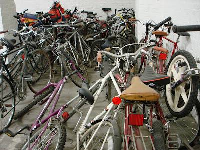
Instead of storing abandoned bicycles indefinitely, a change to the city of Hays abandoned property ordinance will help get the bikes to underprivileged children.

City Commissioners Thursday night approved an amendment allowing lost or abandoned property collected by the Hays Police Department to be donated to a nonprofit organization instead of selling the items at public auction.

Chief Don Scheibler says the change will eliminate need for storage of bicycles.  Now they’ll be sent for refurbishing by prisoners in the Kansas Department of Corrections.

The Hays Police Department currently has more than 140 abandoned bicycles, some collected from as far back as 2008.

No Charges Filed in Pedestrian Death

No charges will be filed in connection with a pedestrian fatality last month in Hays, according to Police Chief Don Scheibler.

79-year-old Gloria Leiker died after being hit by a vehicle January 3rd while crossing West 13th Street near Saint Joseph Church.  Her husband, 81- year-old Gilbert Leiker was injured.  He is now recuperating at home.

They were struck shortly after 6p.m. by an eastbound vehicle driven by 74-year-old Sister Mary Louise Pfannenstiel of Hays.  The couple were ultimately taken to a Wichita hospital.

Rooks County Attorney Ed Hageman decided not to file charges after reviewing reports by the police and the coroner.  Ellis County Attorney Tom Drees removed himself from the case because of his involvement with the church.

Tigers Autograph Session Also Benefits “Kicks for Kids”

It was definitely cold outside, but warm indoors  Sunday afternoon at the Hays Mall where a crowd gathered to meet the Fort Hays State University Tiger basketball teams and cheerleaders, even Victor E. Tiger himself.

The one-hour autograph session brought out fans of all ages.  Senior Forward Matt Simmons of Great Bend particularly enjoys chatting with the kids.  Simmons and his teammates kept busy signing team photo keepsake posters.

Tickets were also on sale for the new “Kicks for Kids” project sponsored by Celebration Community Church.  Proceeds from  the Tigers February 22nd games will be donated to the effort.

More about “Kicks for Kids” later this week on Street Beat.

Managing State’s Snow and Ice Costly

Although there hasn’t been much snow this winter, the Kansas Department of Transportation devotes a lot of resources to clearing roadways.

During an average winter, KDOT uses 4 million gallons of salt brine, 103,000 tons of salt and 574 snow plows on the state’s 10,000-mile system. Acting Transportation Secretary Barbara Rankin says keeping traffic moving is an essential part of the economy. On a typical February weekday, more than $175 million in goods and commuters earning $30 million in daily wages, are on Kansas roads.

A report called “Managing Snow and Ice” is on KDOT’s website at ksdot.org.

Kansas Children with Low Vision Benfit from Lions Grant

Children with vision loss often do poorly in school because they can’t see well.  The Kansas Lions Sight Foundation is changing all that.

The service club’s Statewide Low Vision Program, KANLOVKIDS, has been awarded the first-ever grant from the Lions Clubs International Foundation for low-vision services.   The program will both test children for low vision, and provide specialized care.

Hays doctor Kendall Krug is a low-vision specialist and a Lions Club member.  The local group is helping raise money to purchase a portable vision screener, new technology which will be used by specially-trained adults who work with children.

Dr. Anne Nielsen, also a Lion,  is Outreach Director at the Kansas State School for the Blind in Kansas City.  She co-wrote the two-year grant, which provides 71-thousand dollars.

When glasses or surgery no longer help, KANLOVKIDS helps students learn to cope so they can succeed in school and in life.

“8 Wonders of Kansas” Guidebook Wins Top Award

The Kansas Sampler Foundation was recently notified that their “8 Wonders of Kansas Guidebook” won first place in the North American Travel Journalists Association (NATJA) category for travel book or guide.

Awards are made to publications, travel writers, and photographers whose work is presented in print and electronic media. The competition, now in its 20th year, honors the “best of the best” of travel writing, photography and promotion covering all aspects of the travel industry worldwide.

The “8 Wonders of Kansas Guidebook” debuted in April of 2011.  The 272-page book features the 216 finalists  showcased in the 8 Wonders of Kansas contests, featuring the 24 most significant things to see and do in the categories of architecture, art, commerce, cuisine, customs, geography, history and people.

Published by the Kansas Sampler Foundation,the 6×9″ coffee table/guidebook features more than 800 photos taken by photographer Harland Schuster, Morrill.  The book was written by Foundation director Marci Penner and designed by her sister, Liz (Penner) King.  Mennonite Press, Newton, printed the book.

More than 8,500 books have been sold.

KS House Committee Rejects Funding for Public Broadcasting

TOPEKA, Kan. (AP) — A Kansas House committee has rejected a request from public broadcasters to restore $800,000 in state funding.

Gov. Sam Brownback’s budget proposal included $600,000 for public broadcasting, a cut from the current $2 million state appropriation.

A House budget subcommittee restored $800,000. But Thursday, the full House Appropriations Committee removed that $800,000 and returned the state appropriation to $600,000 for the next fiscal year.

The Lawrence Journal-World reports  State Rep. Pete DeGraaf, a Mulvane Republican, said government needs to get out of public radio. Others said the state’s financial problems required them to make difficult funding cuts.

But several western Kansas legislators said their constituents depend on public radio and public television. Others said public television’s emphasis on early learning and children’s programming was a service to the state.

Dodge City Casino Pays Out Largest State-Owned Casino Jackpot

TOPEKA, KAN. – Gale T. won a $100,000 jackpot at Boot Hill Casino & Resort February 8, 2012, the biggest state-owned casino jackpot paid to a player in Kansas to date. Gale, a western Kansas resident, came to Boot Hill Casino & Resort Wednesday after scheduled appointments in Dodge City. It’s his monthly tradition.

According to Gale, he put $10 in a ‘Five Times Pay’ $5 machine and hit ‘max bet’, using his entire $10 in one play, and hit the jackpot on the first spin.
“When the slot attendant came over, I told her I thought I won $10,000 and she said ‘No, you won $100,000.’ I told her I needed to go find my wife because no one was ever going to believe this,” Gale said.

Joe Sellens, Kansas Lottery Director of Gaming Enforcement and Audit was onsite when Gale hit the jackpot. “There were lots of hugs and handshakes all the way around. Gale sprinted across the floor to find his wife so there was definitely a huge element of excitement in the casino,” he said.

Boot Hill Casino & Resort has paid out more than $20,439,994 in jackpots since opening in 2009.

Boot Hill Casino & Resort, located on Highway 50 in Dodge City, was the first state-owned and -operated gaming facility to open in Kansas.

Phase I of the $90 million project opened in December 2009, with Phase II targeted for completion in fall of 2012. The lottery facility games at Boot Hill Casino & Resort are owned and operated by the Kansas Lottery. The Kansas Racing Commission provides regulatory oversight for the casino.


N.E.W. Will Honor Building Lease

Although N.E.W is closing its Hays facility March 31st, the extended service plan call center  will honor its lease through November 30, 2014.

The building  just off south Commerce Parkway is owned by Heart of America Development Corporation, a local non-profit group.

Heart of America is working with the Ellis County Coalition for Economic Development to market the building.  The group’s acting president, Mark McCullick, says N.E.W is not opposed to someone sub-leasing the building for the duration of the lease.


Copyright Eagle Radio | FCC Public Files | EEO Public File