We have a brand new updated website! Click here to check it out!

Changes To NAFTA Could Have Big Effect On Kansas Agriculture

By Stephen Koranda

U.S. Sen. Pat Roberts, a Kansas Republican, has said he’s open to updates to NAFTA but emphasized that the agreement must preserve or expand export opportunities.
photo by STEPHEN KORANDA

After pushing for changes to the North American Free Trade Agreement, President Donald Trump earlier this year kicked off negotiations among the U.S., Canada and Mexico.

Any major changes to the agreement could have a big impact on Kansas.

Kansas Republican Sens. Pat Roberts and Jerry Moran have said they’re open to updates but emphasize that the agreement needs to preserve or expand export opportunities.

“I support the administration’s effort to modernize and improve NAFTA,” Moran said in a newsletter this month. “I am concerned that withdrawing from the agreement … will harm our farmers and ranchers and cost us jobs.”

Food and ag products are the state’s top export, at more than $3.5 billion last year. Josh Roe, deputy secretary of the Kansas Department of Agriculture, said the two NAFTA trading partners are critical destinations for those exports.

“There have certainly been years where Mexico and Canada are number one and number two,” Roe said.

Roe said NAFTA has led to development of infrastructure and processes that make it easier to export Kansas products to Canada and Mexico.

Last year, Mexico was the top destination for Kansas ag exports and Canada was the third.

Roe said commodity prices are low right now for some products. An upset of the trade agreement could reduce foreign demand and further hurt prices.

“We’re in very depressed agricultural prices now, even with very good export numbers. A further disruption could be absolutely devastating to agriculture and to the Kansas economy,” Roe said.

Certain Kansas products rely especially heavily on exports. Roe said nearly 60 percent of the wheat grown in Kansas last year was shipped to foreign markets.

Roberts disputed what he said was a “pervasive” view that the U.S. economy has not benefitted from NAFTA.

“U.S. agriculture has grown because of agreements like NAFTA,” he said. “And from the farmer in the field to the grocer in the store, American workers have benefited from that growth.”

Trump has been a persistent critic of the trade deal.

“NAFTA is the worst trade deal maybe ever signed anywhere, but certainly ever signed in this country,” he said during a debate on the campaign trail.

Trump has said the U.S. may pull out of NAFTA, but as of now the three countries are in negotiations to instead modify the agreement.

Stephen Koranda is Statehouse reporter for KPR a partner in the Kansas News Service. Follow him on Twitter @kprkoranda.

KHI: Racial and ethnic health disparities in a changing Kansas

KHI

TOPEKA – Over the past decades, the racial and ethnic composition of the population in Kansas has changed. There has been an increase in the number of minorities and a decrease in the number of White, non-Hispanic Kansans, as well as a population shift from rural areas into urban and semi-urban communities.

Changes in the composition of the population could affect health care needs and require the health care system to evolve in order to address social determinants of health that are often distributed differently across population groups.

To describe these changes, the Kansas Health Institute (KHI) has released a new publication, Chartbook: Racial and Ethnic Health Disparities in a Changing Kansas. This update to the 2005 KHI publication, Racial and Ethnic Minority Health Disparities in Kansas, describes the population of Kansas in order to identify disparities that may exist and provides data that will spark conversations about the needs of communities across the state.

The Kansas Health Institute delivers credible information and research enabling policy leaders to make informed health policy decisions that enhance their effectiveness as champions for a healthier Kansas. The Kansas Health Institute is a nonprofit, nonpartisan health policy and research organization based in Topeka, established in 1995 with a multiyear grant from the Kansas Health Foundation.

California man accused of making 911 call in fatal Kan. police shooting

Barriss- photo courtesy Glendale, Calif. police

KANSAS CITY, Mo. (AP) — Police in Los Angeles have arrested a man they suspect made a hoax emergency call that resulted in a SWAT police officer fatally shooting a man at the door of his own home in Kansas, law enforcement officials said Saturday.

Wichita Deputy Police Chief Troy Livingston on Friday characterized the hoax call as “swatting” in which a “prankster” called 911 with a fake story about a shooting and kidnapping to draw a SWAT team to the victim’s address. Authorities haven’t released the name of the man who was killed Thursday, but relatives have identified him as 28-year-old Andrew Finch.

Tyler Barriss, 25, is suspected of making that call and was arrested in Los Angeles on Friday, according to the Los Angeles Police Department and the Wichita Police Department in statements emailed early Saturday afternoon.

Officer Paul Cruz, a spokesman for the Wichita police, said the two city police departments are working with the FBI on the case, but provided no further details including on possible charges or extradition.

In audio of the 911 call played by Wichita police at a news conference on Friday, a man said he shot his father in the head and that he was holding his mother and a sibling at gunpoint. The caller, speaking with relative calm, also said he poured gasoline inside the home “and I might just set it on fire.”

Officers subsequently surrounded the home at the address the caller provided and prepared for a hostage situation. When Finch went to the door, police told him to put his hands up and move slowly.

But Livingston said the man moved a hand toward his waistband — a common place where guns are concealed. An officer, fearing the man was reaching for a gun, fired a single shot. Finch died a few minutes later at a hospital. Livingston said Finch was unarmed.

The officer, a seven-year veteran of the department, is on paid leave pending the investigation.

Police body camera images of Thursday’s night’s fatal incident courtesy Wichita Police

Lisa Finch on Friday told reporters “that cop murdered my son over a false report in the first place.”

In addition to the 911 call, police also released a brief video of body camera footage from another officer at the scene. It was difficult to see clearly what happened.

Dexerto, an online news service focused on gaming, reported that the series of events began with an online argument over a $1 or $2 wager in a “Call of Duty” game on UMG Gaming, which operates online tournaments including one involving “Call of Duty.”

Livingston said investigators were tracking online leads, and a law enforcement official who earlier confirmed Barriss’ arrest said the shooting stemmed from a dispute over “Call of Duty.” The official wasn’t authorized to discuss the investigation publicly and spoke to The Associated Press Saturday on condition of anonymity.

The official said Barriss believed a person involved in the dispute lived at the address, but that investigators don’t believe Finch was the intended target. Finch’s mother said her son was not a gamer.

The official said it wasn’t clear if Barriss was involved in the dispute or if he had been recruited to make the false call.

Court records show Barriss was convicted in 2016 on two counts of making a false bomb report to a TV station in Glendale, California, and sent to Los Angeles County jail for two years. Jail records show he was released in January.

The FBI estimates that roughly 400 cases of swatting occur annually, with some using caller ID spoofing to disguise their number. An FBI supervisor in Kansas City, Missouri, which covers all of Kansas, said the agency joined in the investigation at the request of local police.

In other cases of apparent swatting, three families in Florida in January had to evacuate their homes after a detective received an anonymous email claiming bombs had been placed at the address.

Antlerless-only whitetail season provides one last opportunity

KDWPT

PRATT – Starting January 1, all unfilled 2017 deer permits convert to firearm whitetail antlerless-only permits, providing deer hunters one last opportunity to hunt white-tailed deer before the close of the season. Unit restrictions still apply.

Hunters who possess permits valid in Units 6, 8, 9, 10, 16, and 17 may hunt antlerless white-tailed deer on Jan. 1, 2018; permits valid in Units 1, 2, 3, 4, 5, 7, 11, 12, 13, and 14 may be used Jan. 1-7, 2018; permits valid in Units 10A, 15 and 19 may be used Jan. 1-14, 2018; and, permits valid in Unit 19 may be used Jan. 15-31, 2018.

If a hunter is not already in possession of a whitetail antlerless-only deer permit, they may purchase up to five permits, available over-the-counter Dec. 30, 2017 – Jan. 31, 2018.

A hunter’s first whitetail antlerless-only deer permit is valid statewide (except DMU 18), including all public lands and WIHA. All additional such permits are valid only in units 1, 2, 3, 4, 5, 7, 10A, 11, 12, 13, 14, 15, and 19; on private land with landowner permission; on Walk-In Hunting Areas; and on Glen Elder, Kanopolis, Kirwin, Lovewell, Norton, Webster and Wilson wildlife areas.

For more information on hunting the antlerless-only whitetail season, consult the 2017 Kansas Hunting and Furharvesting Regulations Summary or visit ksoutdoors.com/Hunting/Big-Game-Information/Deer.

Deadly year: Homicides near record level in Kansas City

Police: Three died after May 9 shooting at a Kanas City home-photo courtesy KCTV

KANSAS CITY, Mo. (AP) – Just three years after Kansas City, Missouri, was being hailed for reducing homicides, the city is seeing a staggering increase in 2017.

The Kansas City Star reports that 149 people have been killed in homicides this year, the highest total since a record 153 in 1993, at the height of killings fueled by crack cocaine and gangs.

The city’s efforts to reduce homicides drew national attention in 2014, when just 82 killings occurred. But Kansas City had 111 homicides in 2015, 131 last year, and the trend worsened in 2017.

It’s a big problem on both sides of the state. St. Louis this year has topped 200 killings for the first time in more than two decades.

Norton County Hospital names CEO

Gina Frack

NCH

NORTON – Norton County Hospital’s Board of Trustees has hired Gina Frack to be the new chief executive officer, effective Dec. 23, 2017. Frack has served in the interim CEO position since the end of June 2017. She joined the Norton County Hospital team as chief operating officer in October 2015, after serving as administrator of the Norton County Health Department and Home Health Services for 18 years.

Frack pursued undergraduate studies from Kearney State College, now the University of Nebraska at Kearney, and her RN from Central Community College in Grand Island, Nebraska. After working as a nurse in various capacities in southwest Nebraska and northwest Kansas, she obtained a bachelor’s degree in health care management from Bellevue University in Nebraska.

Frack has a passion for rural health and preserving a rural way of life. She has been invited to speak, present and serve on committees for numerous organizations, such as the Robert Wood Johnson Foundation, Kansas Health Foundation, Kansas Department of Health and Environment, and National Association of County and City Health Officials (NACCHO). She has advocated for rural health issues in such places as Washington, D.C.; Arlington, Virginia; and many places in Iowa, Nebraska and Kansas. She has also led national webinars for NACCHO. She enjoys speaking on her passion of rural places and the people who live there.

“It is truly an honor to be in this position,” Frack said. “Norton County has a long-standing history of providing health care to meet the needs of our county and surrounding area. I am excited to work with the communities we serve, all the hospital staff and board to meet the ever-changing demands of health care.”

Kansas man dies in pickup rollover accident

SHERIDAN COUNTY —A Kansas man died in an accident just before 5am. Saturday in Sheridan County.

The Kansas Highway Patrol reported a 2004 Dodge truck driven by Alfonso Roa-Nolasco, 27,
Emporia, was northbound on Kansas 23 when it crossed onto Sheridan County Road 00 thirteen miles north of U.S. 24.

The vehicle entered the right ditch. The driver overcorrected and the vehicle one rolled multiple times. The driver was ejected.

Roa-Nolasco was pronounced dead at the scene. He was not wearing a seat belt, according to the KHP.

Police: Body found after crews put out Kansas car fire

First responders on the scene of Saturday’s car fire-photo courtesy WIBW TV

SHAWNEE COUNTY — Law enforcement authorities are investigating a suspicious fire in Shawnee County.

Just before 2a.m. first responders were dispatched to a car fire near the intersection of 15th and Hudson in Topeka, according to a social media report from police. Authorities found a body inside the vehicle.

Police did not release additional details but did indicate they would have more information available later Saturday.

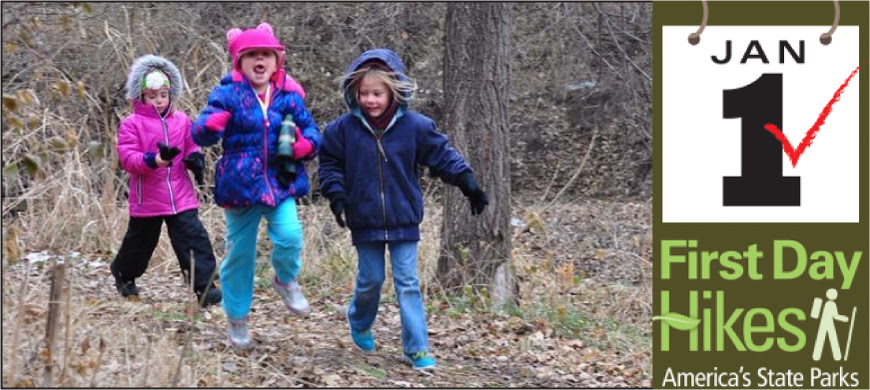
‘First Day Hikes’ at Cedar Bluff, Wilson state parks Jan. 1

KDWPT

PRATT – You don’t have to feel guilty about the sweets and treats you indulged in over the holidays, because staff at Kansas State Parks have a fun way for you to get “back on track” with the New Year.

A total of 18 “First Day Hikes” will be hosted around the state Jan. 1 at select Kansas state parks where park staff will be excited and ready to make your start to the New Year a fun and healthy one!

First Day Hike events, most of which are led by a guide, will take you on a scenic route through some of the most wild and unique landscapes the state has to offer. Select hikes may also include educational programs and refreshments, so bring the kids for family fun.

Hikers should wear warm clothing and good trail footwear and bring water, a camera and binoculars. Pets are welcome, but must be leashed at all times. Don’t forget your favorite animal identification guides, too, as you’re sure to spot a neat bird or other wildlife.

To find details on a First Day Hike near you, visit ksoutdoors.com/State-Parks/Special-Events/First-Day-Hikes.

After you’ve finished your trek, be sure to share your photos with staff and fellow hikers by using the hashtags #FirstDayHikes and #MyKSStatePark.

A state park daily vehicle permit ($5.00) is required to enter select parks.

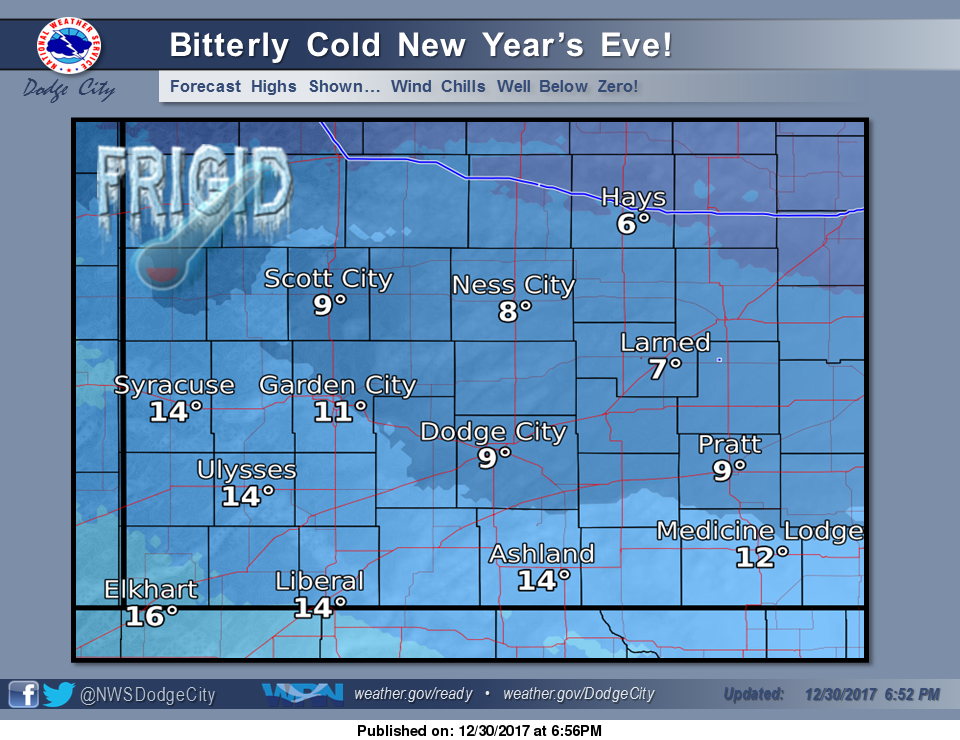
Bitterly cold Sunday

…A WIND CHILL ADVISORY REMAINS IN EFFECT UNTIL NOON MONDAY…
Today
Partly sunny and cold, with a high near 6. Wind chill values as low as -21. North northeast wind 10 to 14 mph.

Tonight
Partly cloudy, with a low around -7. Wind chill values as low as -17. Northeast wind 5 to 9 mph.

New Year’s Day
Mostly sunny and cold, with a high near 11. Wind chill values as low as -15. Light and variable wind becoming southeast 5 to 8 mph in the morning.

Monday Night
Partly cloudy, with a low around -1. Wind chill values as low as -13. Southeast wind around 7 mph.

Tuesday
Sunny, with a high near 27. Southwest wind 7 to 10 mph.

Tuesday Night
Mostly clear, with a low around 14.

Wednesday
Sunny, with a high near 33.

Wednesday Night
Partly cloudy, with a low around 11.

Thursday
Mostly sunny, with a high near 33.

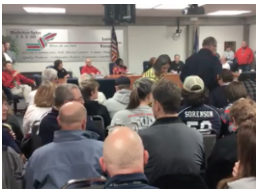
School Board Limits On Public Comment May Face Legal Challenge In Kansas

The former legal director for the American Civil Liberties Union of Kansas thinks a practice among some school boards of restricting patron complaints at public meetings eventually will end up in court.

Doug Bonney, legal director emeritus for ACLU Kansas, said if barring complaints about school board members, the superintendent or employees is common, that doesn’t make it right.

“What I think that means,” he said, “is that eventually we will get a complainant and we will take this on in litigation. It’s so widespread that it’s almost certain to be litigated at some point.”

The American Civil Liberties Union of Kansas wrote to the Shawnee Mission school board in May and again in December asking that it drop restrictions against people voicing their complaints at meetings.

There are no tallies of how many of Kansas’ 286 school boards specifically bar parents and others from airing grievances about employees or board members in public. But Angie Stallbaumer, policy specialist and staff attorney at the Kansas Association of School Boards, said it isn’t unusual for boards to set some parameters for comments. Protecting privacy is a key motivation for doing so, she said.

“We don’t want to get to a situation where people don’t want to get into the profession because they don’t want their private work stuff discussed out in the open,” Stallbaumer said.

The Topeka school board, for example, has a policy barring the public from complaining about the superintendent or other employees at its meetings. Such complaints must be submitted in writing to the superintendent or, if they concern the superintendent’s actions, to the school board president or clerk.

View the Topeka school board policy

Wichita Public Schools, meanwhile, has a policy that doesn’t permit “attacks by public speakers on the personal integrity, character, or competency of any employee and/or student of USD 259” at its public meetings. But the board allows people with such comments to ask to make them in closed-door sessions.

Bonney said these types of public comment restrictions caught his organization’s eye when the Shawnee Mission school board earlier this year interrupted a patronwho was complaining about a perceived conflict of interest on the board.

Allowing patrons to praise district leaders and staff but not criticize them violates the First Amendment, he said.

“I’m quite confident on our position,” he said.

The ACLU wrote to the Shawnee Mission school board in May and again in December asking that it drop restrictions against people voicing their complaints at meetings.

Read the ACLU’s letter to the Shawnee Mission school board

Shawna Samuel, spokeswoman for the Shawnee Mission district, said the board replied Dec. 7 in a statement by Vice President Brad Stratton.

In the statement, Stratton indicates the board will revisit the matter after newly elected members join next month.

“Once the Board of Education has had an opportunity to review the items outlined in the letter, and has consulted with legal counsel, a thorough response will be provided,” Stratton said.

Stratton indicated the board would consider the ACLU comments as it balances free speech rights with privacy rights.

View the Shawnee Mission school board policy

Stallbaumer said case law talks about employers’ responsibility to protect the privacy of their employees. School boards aren’t required by law to allow public comment periods, she said. And if they do, they can limit the topic of conversation — for example, a comment period specifically for input about a potential school closure — or place other “reasonable time, place and manner restrictions.”

“That’s what we’re trying to make clear,” she said. “The time for public comments is something that the boards are undertaking voluntarily.”

Bonney said boards can indeed choose not to hear any public comments whatsoever or even set some basic rules, such as allowing three minutes per commenter. But he added: “Once you open it up, then you have to abide by the First Amendment.”

Celia Llopis-Jepsen is a reporter for the Kansas News Service.  You can reach her on Twitter @Celia_LJ.

Copyright Eagle Radio | FCC Public Files | EEO Public File