Preliminary estimates reported by the Kansas Department of Labor and Bureau of Labor Statistics show a seasonally adjusted unemployment rate of 3.2 percent in September. This was unchanged from 3.2 percent in August and down from 3.3 percent in September 2018.
“Kansas job growth shows a 1.5 percent gain over the last year which is on par with the national job growth,” said Secretary Delía García. “Additionally, Kansas posted a significant gain in the size of the labor force adding 3,525 people in September.”
Jobless rates fell precipitously across northwest Kansas, with Ellis, Rawlins, Thomas, Wichita, Scott, Osborne, Gove, Norton and Lane counties all below 2 percent.
Unemployment is Ellis County fell nearly a full percentage point, from 2.8 percent in August to 1.9 percent in September.
The Rooks County jobless rate fell from 4.8 percent to 2.9 percent.
Seasonally adjusted job estimates indicate total Kansas nonfarm jobs decreased by 2,500 from August. Private sector jobs, a subset of total nonfarm jobs, decreased by 900 from the previous month.
“Preliminary estimates show Kansas lost 2,500 jobs in September. This follows five consecutive months of gains,” said Senior Labor Economist, Tyler Tenbrink. “Compared to last September, the rate of job growth in Kansas is in line with the nation.”
Since September 2018, Kansas gained 20,800 seasonally adjusted total nonfarm jobs and 16,200 private sector jobs.
2018 Hays Alley Cleanup (Photos and video by Hays Post)
City of Hays
The 2019 annual alley cleanup will consist of one and only one sweep through the city beginning Monday.
No set schedule has been established; however, residential curbside services will be first with residential regular alley services following.
The city-wide general schedule for alley services will start after curbside collections are completed. The number of employees committed to the task may vary from day to day; therefore, crews are unable to predict when they will be by a residence. City crews have a 20-minute time limit per residence. Any items remaining after 20 minutes of pickup will be the responsibility of the property owner.
As in years past, the city WILL NOT pick up tires and hazardous waste. Tires should be disposed of at the Ellis County Landfill, and hazardous waste items should be disposed of at the Ellis County Hazardous Waste Facility. Please call 628-9460 or 628-9449 for detailed information.
The annual Alley Cleanup Program is an opportunity for residents to discard items that would not be picked up in normal trash collection. Alley cleanup is for city of Hays residential customers paying for refuse services.
Waste should be placed in four separate piles in preparation of the alley cleanup.
The piles should be organized in the following manner:
1.Tree limbs and brush (no longer than 12 feet in length or 6 inches in diameter); bamboo bundled in 4’ lengths; all yard and garden waste MUST be bagged
2.Construction and Demolition Debris, i.e., lumber, drywall, bricks, sinks, wires, etc. (please pull or bend over nails and place small quantities of concrete, bricks, and plaster in containers)
3. White Goods/Metals, i.e., guttering, siding, washing machines, dryers, refrigerators, metal swing sets, propane tanks for grills, etc.
4. Municipal Waste (all other items), i.e., furniture, carpet, TVs, computers, etc.
**TO AVOID WRONGFUL PICK UP, “TREASURED ITEMS” SHOULD BE TAGGED OR REMOVED FROM THE COLLECTION AREA**
Help make the city of Hays alleys clean and safe for all.
Free disposal of tree limbs is available for Hays residents at the Ellis County Sanitary Landfill, 1515 W 55th, Monday to Friday – 8 a.m. to 5 p.m. and Saturday – 9 a.m. to 4 p.m.
THOMAS COUNTY — One person was injured in an accident just after 3 a.m. Friday in Thomas County.
The Kansas Highway Patrol reported a 2014 Ford F150 driven by Cale A. Prewo, 18, Grinnell, was eastbound on Interstate 70 four miles east of the Brewster exit.
The pickup left the road to the left, and the driver’s side of the vehicle struck the guardrail. The driver was not wearing a seatbelt and was ejected, the KHP reported. The pickup came to rest in the median.
Education: B.A. Philosophy 2007 University of Kansas; J.D. 2009 University of Kansas
Do you have a student currently attending USD 489 schools? No
Qualifications? I am a life long resident of Hays who wants to help any way I can make this community a better place to live.
Do you support USD 489 trying for another bond issue? What do you think that bond should include? If you don’t support a bond issue, how do you think the school district should address its infrastructure needs?
Passing a bond has to be the number one issue for all the school board members. Our buildings get worse every year, and each year we put off passing a bond, it becomes more expensive to do what needs to be done. The school board members need to be leaders in the community to get a school bond passed that meets the needs of our community while also being fiscally responsible.
What would you do to secure the financial health of the school district?
Securing the financial health of a public entity is an ongoing responsibility of all elected officials. The previous school boards have done an overall good job of stretching dollars to make sure the taxpayers are getting the most bang for their buck. We need to work to continue that strategy, while making sure we are providing a quality education to all our students.
The Hays school board is at impasse with its teachers for the second year in a row. What would you do to improve relations with teachers?
If on the school board, I would listen to every idea KNEA presents for resolution of the problem. Often times, they have several ideas that fall on deaf ears because of individuals that are more interested in fighting with the union than in solving the problem. We need board members that have the best interest of community at heart instead of a personal agenda to fight with those they don’t like.
Do you support the district’s current one-to-one technology policy? If not, what would you propose?
Technology in education is a never ending arms race. Fall behind, and your students are left behind. I understand others’ reluctance to pay for such an enormous endeavor, but if we don’t pay for it now, the whole community suffers with a generation of students unprepared for tomorrow’s challenges facing the world, our country, and especially our community.
How would you support the district in its work to improve student performance?
Passing a bond is a very important step in this area. Students learn better in an environment that cultivates an enthusiasm for learning. Taking care of our teachers makes sure we keep quality educators in our community and don’t lose them to other districts.
Is there anything else you would like to add about you or your campaign?
The foundation of any great community is a great education system. For too long, we have not done what we need to do to maintain the long-term stability of our local education system, and that has both short-term and long-term negative impact on our city. I am running to provide help wherever I can to take the next step Hays needs to take to insure the long term stability of the community. That starts with developing a bond measure that addresses our needs, but is also fiscally responsible. I will do everything I can as a board member to make sure a plan is developed that meets the needs and expectations of the community.
OSBORNE — The Osborne County Hall of Fame’s Class of 2019 consists of an Air Force flying ace, a wildly successful craft brewer, a noted painter, a revered illustrator and artist, and the county’s first military veteran. To read their full stories go to the Hall’s online website at www.wordpress.com.
Gerald “Jerry” Jean Beisner (1923-2018) was born on September 30, 1923 in Salina, Kansas and spent his early years in the community of Natoma, Kansas. After attending Maur Hill High School in Atchison, Kansas, Jerry joined seven of his brothers and sisters in the war effort by enlisting in the Army Air Corps in 1943. Following flight training Jerry earned his wings and began a distinguished 30 year career in the United States Air Force, retiring as a Colonel. During his career Jerry flew fighter missions in the Korean conflict and in Vietnam. He traveled all over the world, served as a fighter squadron commander, a Wing Director of Operations at MacDill AFB, and Tactical Air Command Chief of Safety at Langley AFB, in addition to countless other assignments. Gerald received many awards and honors, including the Distinguished Flying Cross for Heroism with One Oak Leaf Cluster, the Air Medal with 15 Oak Leaf Clusters, the Legion of Merit, and the Bronze Star. After retirement from the Air Force Jerry founded the market research firm Beisner Research Associates and continued in that business for approximately 30 years. He passed away in Macon, Georgia.
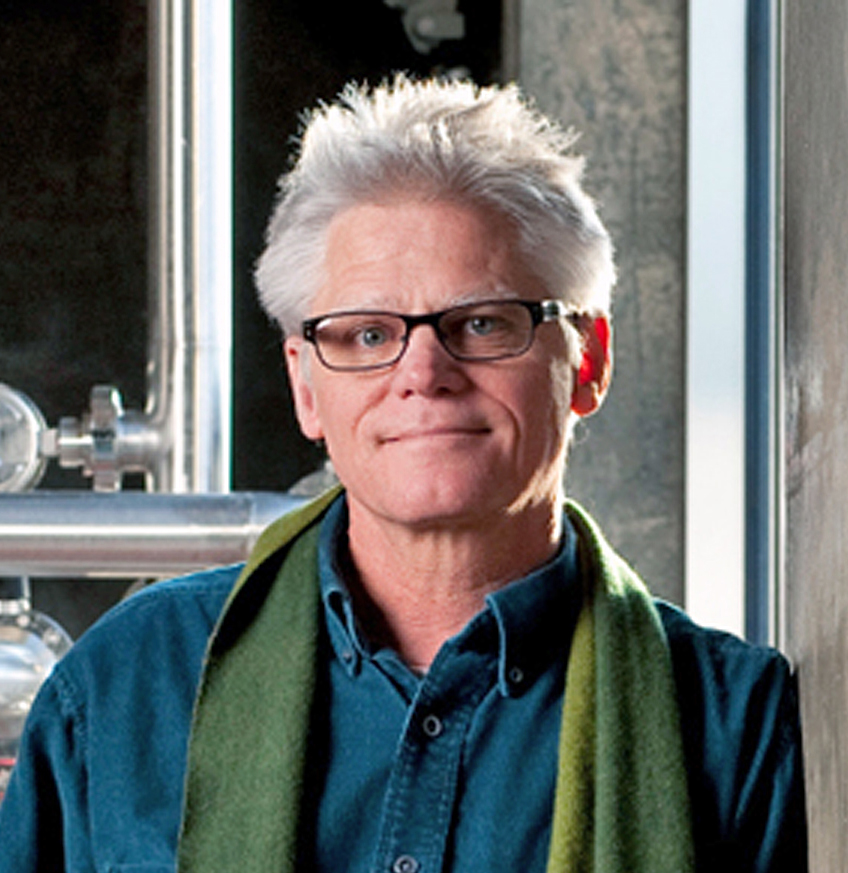
John Reed McDonald (born 1953) was the founder and guiding force behind one of the most prosperous and well-respected regional specialty breweries in the United States. Born in Osborne, Kansas, John graduated from the University of Kansas in 1976 with a degree in fine arts and then moved to South America and taught in Ecuador. Upon his return, he worked as a carpenter for 15 years when he decided to market the beer he had been homebrewing in his woodshop. In 1988 John McDonald formed the Boulevard Brewing Associates Limited Partnership in Kansas City, Missouri and the first batches of beer were produced in the fall of 1989. A major expansion in 2006 made Boulevard Brewing Company the largest specialty brewer in the Midwest. By 2017 Boulevard Brewing was the 12th largest craft brewer in the nation and served in 19 U.S. states. John McDonald served as its President and also served as its Chief Executive Officer until September 5, 2012. In October 2013 the Duvel Moortgat Brewery of Belgium bought a controlling interest in the Boulevard Brewing Company. At the time the company was brewing 178,000 barrels a day and selling in 40 states. In 2017 those figures had leaped to 640,000 barrels a day and selling in 42 states and territories and in 11 foreign countries. After the sale John McDonald became a developer, responsible for the renewal of the dilapidated East Bottoms and West Bottoms areas in Kansas City into modern centers of commercial and recreational commerce. John also co-founded Ripple Glass, a glass recycling company that plays a significant role in making Kansas City a green business-friendly location. In 2018 McDonald served as a director of the Greater Kansas City Chamber Of Commerce.
Vinnorma (Shaw) McKenzie (1890-1958) was born in Downs, Kansas. She began drawing and painting at an early age, winning national prominence. After Vinnorma graduated from the Downs High School she attended the Chicago Art Institute two years and the Chicago Institute of Fine Arts. Vinnorma married John Harrison McKenzie in Downs, Kansas, on July 9, 1921, and settled in Port Huron, Michigan. She was art instructor in the public schools there for two years and attended the summer session of the Chicago Alumni society of Painting, and the Art Students’ league in Woodstock, New York. Vinnorma was the subject of numerous art exhibits in Michigan, New York City, at Wichita, Kansas, and with the Detroit Society of Women Painters, winning several awards. Vinnorma became ill with leukemia and died in Sarnia, Michigan in 1952 at the age of 58.
Willis Acton Pyle (1914-2016) was born in Portis, Osborne County, Kansas. He moved to Bethune, Colorado with his family as a child and later to Boulder, Colorado. He later studied art at the University of Colorado but left school to join Disney Studios in 1937. He worked on the classic animated films Pinocchio (1940), Fantasia (1940), and Bambi (1942), before leaving the studio during a strike in 1941. Willis subsequently worked briefly with Walter Lantz on Woody Woodpecker cartoons. He served in the U.S. Army Air Corps during World War II, animating training and propaganda films for the First Motion Picture Unit. Willis worked as an animator for United Productions of America (UPA) after the war. He also worked as a fashion illustrator for the magazines Vogue and Harper’s. Willis was animator for the Oscar-nominated cartoon shorts The Magic Fluke (1949) And Ragtime Bear (1949), which introduced the character of Mr. Magoo. He also animated Dr. Seuss’ animated short Gerald McBoing-Boing, which earned an Academy Award in 1951. Willis formed his own studio, Willis Pyle Productions, in the early 1950s. He retired from animation in the early 1980s but briefly returned to work on the 1989 televisions series This is America, Charlie Brown. He became a leading painter of watercolors and oils, and was frequently exhibited at New York galleries. Willis was the older brother of actor Denver Pyle (of Grizzly Adams and Dukes of Hazard fame), who died in 1997. He died at his penthouse apartment on Broadway in New York City at the age of 101.
Edward R. Roche was born in 1846 in County Tipperary, Ireland. He immigrated to the United States aboard the passenger ship “Fidelia” without his parents or any known family. The “Fidelia” left Liverpool, England, and arrived in New York City, New York, on August 5, 1851. In March 1866 Edward enlisted in Company I of the 2nd U.S. Cavalry at Fort Leavenworth, Kansas. He was assigned to escort duty for the Deputy U.S. Surveyors in the summer of 1866 as they set the boundaries for what is now Osborne County, Kansas. Roche was killed in action defending the surveyors during an Indian attack on July 21, 1866, “near the Solomon River” in Osborne County, the first military veteran killed in the line of duty within the county’s environs. A prominent headstone was placed at Roche’s initial burial site, atop a knoll near where the four corners of Penn, Hancock, Corinth, and Bloom Townships now meet. He was later reinterred in the Osborne City Cemetery in 1879.
The Osborne County Hall of Fame (OCHF) is an all-volunteer organization first formed in 1996 to celebrate the heritage of Osborne County, Kansas, on its 125th anniversary of organization. Since 2001 the OCHF has annually inducted three to five individuals tied to Osborne County who have made an impact at the local, state, regional, national, and international levels. “To honor not only those who are famous but also those who should be famous” is the unofficial motto of the OCHF. The honorees are chosen by a committee of past and present Osborne County citizens. To see all of the stories of the OCHF inductees be sure to visit the Hall’s website at www.ochf.wordpress.com.
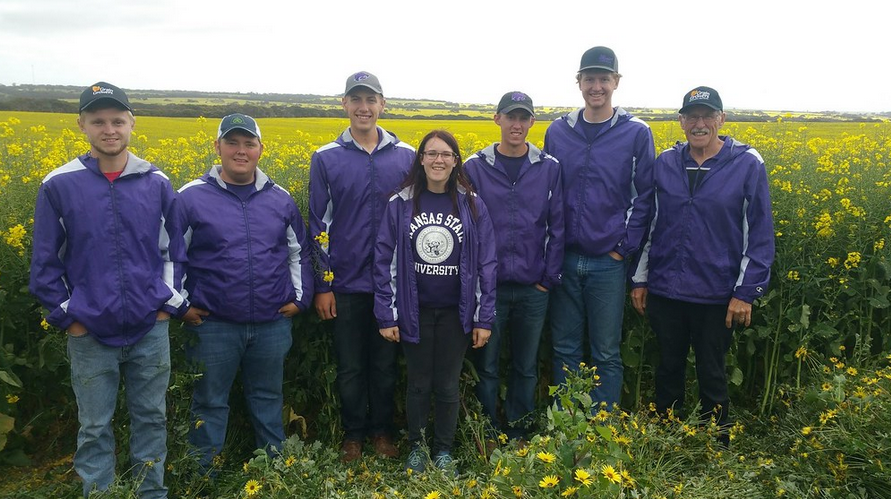
K-State Collegiate Crops Team at the Australian Universities Crops Competition (l to r): Wes Jennings, Nate Dick, Jayden Meyer, Madison Tunnell, Luke Ryan, Blake Kirchhoff, Dr. Kevin Donnelly – Coach
Junior from Smith Center also part of the crops team making trip
MANHATTAN – A Kansas State University student took top honors and the K-State Crops Team placed second in the Australian University Crops Competition recently. The event was hosted by the Australian Grain Growers organization and was held at the University of Adelaide in South Australia.
Luke Ryan, junior in agronomy from Solomon, Kansas won top individual honors overall.
The University of Sydney placed first in the team competition, K-State placed second, and Charles Sturt University from Wagga Wagga, Australia, was third.
Three students from South Dakota State University traveled with the K-State team and participated in the competition. The teams competed against agricultural universities from across Australia.
K-State Crops Team members making the trip included top winner Luke Ryan, plus Jayden Meyer, Smith Center, junior in agricultural economics; Wes Jennings, Abilene, senior in agronomy; Nate Dick, Inman, senior in agronomy; Madison Tunnell, Olathe, junior in agronomy and Blake Kirchhoff, Hardy, Nebraska, junior in agronomy. The team was accompanied by coach Kevin Donnelly, professor of agronomy. This was the fifth trip for the K-State team since 2012 to participate in the Australian competition.
Ryan, Meyer and Jennings were awarded a stipend from the American Society of Agronomy to cover part of their travel expenses as a result of previously placing in the top three at the U.S. Collegiate Crops Contests in Kansas City and Chicago last November. Additional sponsors of the K-State team were Kansas Grain Sorghum, Kansas Corn, Syngenta, and the K-State Department of Agronomy. The College of Agriculture also provided an international travel scholarship to the K-State students.
The trip was a combination of work, learning and sightseeing, which also proved educational for the students.
The competition portion spanned three days at the University of Adelaide’s Roseworthy Campus. The contest included a seed identification section, three exams over production of selected Australian crops, a business management problem, field yield estimates and management recommendations, and a live crop, weed and disease evaluation component.
Before the competition, the group spent a day touring tropical agriculture in Queensland, learning about bananas, coffee, avocados, and sugarcane, and visited a large grain farm in South Australia featuring mixed cropping of wheat, canola and pulses. After the contest, they visited a sheep farm, a cherry orchard, a vineyard, and an apple orchard and processing facility in the Adelaide Hills area. They also travelled to Kangaroo Island, visiting grain farms and KI Pure Grain, the island’s major cooperative grain handling and export business. Learning about canola and Australian white wheat production, ryegrass herbicide resistance problems, and the use of pulse crops such as lentils and fava beans in crop rotations were highlights for the U.S. teams.
The students also took a snorkeling trip to the Great Barrier Reef at Cairns, with a visit to Sydney Harbor and the Sydney Opera House on the trip to Adelaide. After the contest, they spent two days touring Kangaroo Island. Highlights were observing the majestic coastal rock formations, beaches with seals and dolphins, and kangaroos and koala bears in the wild.
Western Kansas Human Resource Management Association will hold its monthly meeting on Wednesday, Dec. 11, at the Robbins Center (Eagle Communication Hall), One Tiger Place.
Registration is from 11:15 to 11:30 a.m., with a short business meeting starting at 11:30 a.m.
The program for the December meeting will be “Supporting Moms in the Workplace,” presented by Brenda Bandy with Kansas Breastfeeding Coalition. The program will be submitted for SHRM continuing education credits. WKHRMA members can RSVP at wkhrma.shrm.org. The deadline to RSVP is noon on Dec. 6.
WKHRMA is an affiliate chapter of SHRM (Society for Human Resource Management), a local professional organization for persons engaged in personal or human resource management. For more information on WKHRMA, visit wkhrma.shrm.org.
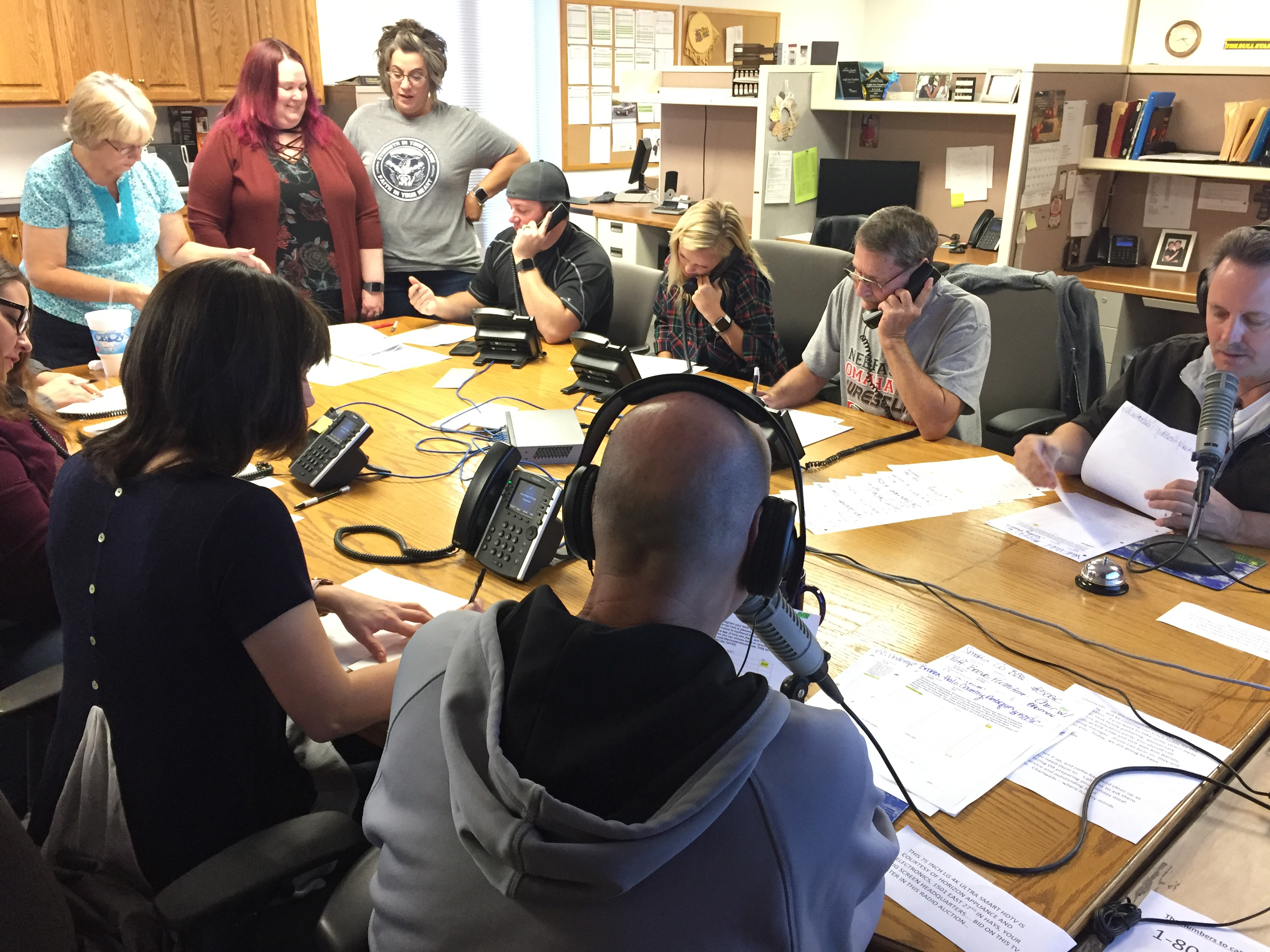
The final day of the Eagle Radio Auction kicks off at 8 a.m. Friday on radio stations 101.9 KKQY and 94.3 FM and 1400 AM KAYS.
There are thousands of items to bid on and buy, including a 1997 Honda Goldwing GL 1500 Aspencade from Day Motorsports in WaKeeney.
This bike looks new and is in great shape. Features include saddle bags, a trunk, a fairing, and is pearl white in color. The bike has 58,555 miles and was a local trade. The retail price of this motorcycle is $5,895.
For more information on this motorcycle, call Day Motorsports at 785-743-5723.
Burdett Loomis, Professor, Political Science, College of Liberal Arts and Science, University of Kansas
As the dust settled after the 2018 Republican gubernatorial primary election, Secretary of State Kris Kobach defeated incumbent governor Jeff Colyer by 350 votes, of 128,838 total votes (40.6%). Lagging far behind were moderate Jim Barnett (8.8%), Insurance Commissioner Ken Selzer (7.8), and three other candidates, who garnered 2.2% of the vote.
In assessing the results, Republican political pros were despondent and Democrats gleeful. Republicans had nominated the candidate who was, by far, the most likely to lose the general election to Democrat Laura Kelly. Indeed, that is exactly what happened, as Kobach extreme’s conservatism turned off many Republicans and independents in the November contest.
It is a truism that the rules often help determine who wins a contest. Political scientists have long understood that rules are never neutral. But there are ways to produce better outcomes than Kobach’s 2018 candidacy. Most notably, Republicans could have used ranked choice voting (RCV) to determine the primary winner, with voters ranking the candidates in order of their preference. If no candidate receives a clear majority (50 percent), the candidate with the lowest number of votes is eliminated, and his or her votes are distributed to the second-place choices. This continues until a winner is receives a majority in an “instant runoff.”
In 2018, Governor Colyer would almost certainly have emerged as the winner, since the trailing candidate with the largest cache of votes, Jim Barnett, would have had his tallies go overwhelmingly to Colyer, as would have a fair number of Selzer’s.
The benefits of RCV are numerous, but let’s consider just two. First, Republicans would have put forward their strongest candidate. Second, those voters who supported either Barnett or Selzer could have made a sincere first vote choice, backed up with a strategic second choice.
Nor is the Kobach example singular in Kansas GOP politics. In 2018, newcomer Steve Watkins won the 2nd District Republican nomination with 26.5 percent (20,052) of all votes. RCV procedures would have likely given the nomination to one of his establishment GOP challengers, as most Republican voters viewed Watkins as unqualified. Still, with just a quarter of the primary vote, he won the right to run (and narrowly win) as a Republican in the general election.
A similar scenario propelled Tim Huelskamp into office in the 1st District in 2010, when the ultra-conservative state senator won the nomination with less than 35 percent of the vote. His election in this traditionally Republican seat led to three terms of controversy, before Roger Marshall unseated him in the 2016 primary.
Next spring, Kansas Democrats will use RCV in their May presidential primary; by then, several candidates will have dropped out. The system might be best employed when a large number of candidates remain in the race. Still, it’s a step in the right direction.
Across the nation, many cities have adopted RCV, and Maine has used it in a general election. Indeed, the Maine results demonstrate the impact of RCV, as the Democratic challenger in the 2nd congressional district trailed the Republican incumbent by 2,171 votes, only to emerge victorious by 3,519 votes when two independent candidates’ second-choice votes were redistributed.
A majority candidate thus won election, and more than 16,000 independents did not “waste” their votes.
As we worry about legitimacy, representation, and participation, ranked choice voting is fast becoming a highly attractive option to encourage voting by all factions while producing majority victors. A win-win situation for parties and voters.
Burdett Loomis is an emeritus professor of political science at the University of Kansas.
TOPEKA – Four Kansas educators are being recognized for their outstanding teaching skills through the prestigious Presidential Award for Excellence in Mathematics and Science Teaching (PAEMST) program.
The White House Office of Science Technology Policy (OSTP) and the National Science Foundation (NSF) announced Tuesday, Oct. 15, 2019, that Heidi Albin, Complete High School Maize (CHSM), Maize Unified School District 266; Monica Dreiling, Lincoln Elementary School, Hays USD 489; Sarah Rand, Central Heights Elementary School, Central Heights USD 288; and Stephen Smith, Christa McAuliffe K-8 Academy, Wichita USD 259, are among 215 individuals being presented with the honor.
Albin and Smith were named national finalists for 2017, and Rand and Dreiling were named national finalists for 2018. The 2017 and 2018 national finalists weren’t named by OSTP and NSF until Oct. 15, 2019.
The Presidential Award for Excellence in Mathematics and Science Teaching, which was established in 1983 by Congress, is presented annually to outstanding K-12 science and mathematics teachers from across the country.
Nominees complete a rigorous application process that requires them to demonstrate their excellence in content knowledge and ability to adapt to a broad range of learners and teaching environments. Winners are selected by a panel of distinguished scientists, mathematicians and educators following an initial selection process done at the state level.
Each year, the award alternates between educators teaching kindergarten through sixth grade and those teaching seventh through 12th grades.
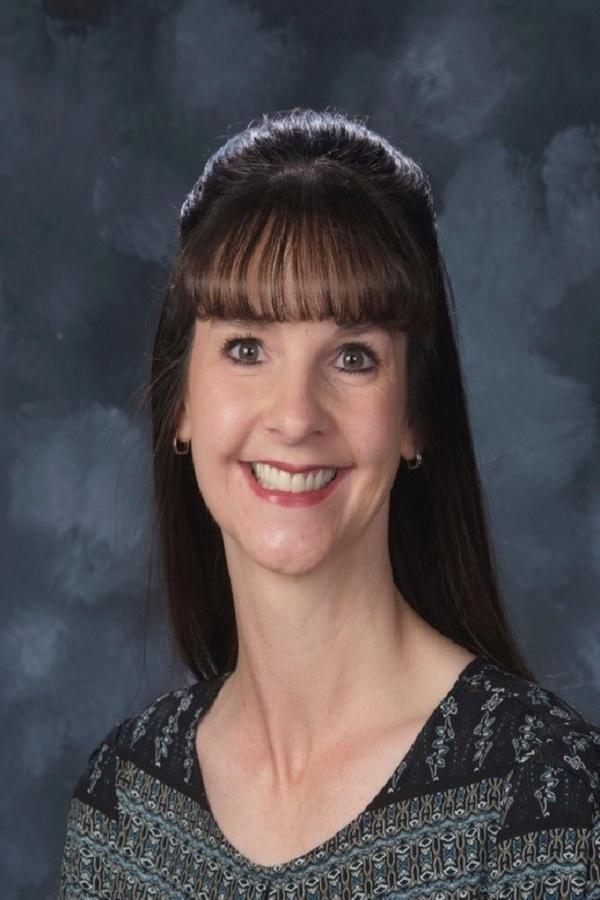
Dreiling has been an educator for more than 20 years, teaching fifth-grade science and language arts for the past five years at Lincoln Elementary School. She also has taught special education for 15 years at Lincoln Elementary, LaCrosse Elementary and Ruppenthal Middle School, Russell County USD 407. Dreiling has been an adjunct instructor at Fort Hays State University for 12 years.
She has been awarded numerous grants, which have created unique science learning opportunities, including an engineering unit to create a prosthetic leg for an injured dog and an intergenerational STEM partnership with assisted-living residents.
Dreiling received a bachelor’s degree in elementary education and a master’s degree in cross-categorical special education from Fort Hays State University. She is certified in kindergarten through ninth-grade elementary education and K-12 special education. She has endorsements for ESOL, gifted and building leadership. Dreiling is a National Board Certified Teacher.
“The Presidential Award is an immense honor. This prestigious award could not have been achieved without inspiration, guidance and encouragement from students, their families, colleagues and my own family,” Dreiling said. “These individuals, combined with a supportive work environment, are truly a blessing! Receiving this award further ignites my passion for teaching and validates that all students can successfully engage in rigorous lessons that increase confidence and cultivate an interest in science.”
Albin has spent the past 10 years as the science teacher and character education coordinator at CHSM. She co-authored “186 Days of Character,” a year-long character education curriculum that is freely distributed across Kansas. Albin also successfully implemented a facility therapy dog program at her school, helped CHSM receive recognition as a Kansas Association of Conservation and Environmental Education Green School of the Year and established a handicap accessible community garden.
Albin serves on the board of directors for WILD KS and has written and implemented curriculum for fishing, wilderness survival and camping. She also is a 2017 Milken Educator.
She has a bachelor’s degree in cellular molecular biology and a master’s in secondary education from Fort Hays State University with certifications in biology, chemistry, agriculture and earth and space science.
“Receiving the Presidential Award means that I have the responsibility to represent teachers well and help other teachers reach their goals,” Albin said. “The award places me in a position to serve the profession and step up in any way I can to help others. I also see this award as a reflection not of myself, but of my school and fellow staff members. The staff at Complete High School Maize have all dedicated their lives to helping struggling students and I am in awe of their passion and commitment.”
Smith has been an educator for 22 years. He worked at Christa McAuliffe K-8 Academy in Wichita for seven years before recently joining the staff at Allison Traditional Magnet Middle School, also in Wichita USD 259, as a technology teacher. He also spent 15 years teaching second through fifth grade at McLean Science and Technology Magnet School, Wichita USD 259. He has written computer applications and developed project-based learning activities to engage his students in math.
Smith has coached LEGO and VEX Robotics and works with Wichita State University to lead robotics summer camps. He earned his bachelor’s degree in business administration with a computer science minor; a bachelor’s in elementary education; and a master of education in curriculum and instruction – all from Wichita State University. He is certified in middle school math, elementary education, English to Speakers of Other Languages (ESOL), technology education and is a National Board Certified Teacher.
“Receiving the Presidential Award is not so much a recognition of my accomplishments, but a celebration of those who have invested, guided, and inspired me to be a life-long learner,” Smith said. “Each day, I stand in the company of dedicated, hard-working and talented teachers who challenge and encourage me to be my very best. I strive to provide that same motivation to the students I teach. Being recognized for this is truly an honor!”
Rand has taught at Central Heights Elementary School for the past five years. She spent her first three years in education teaching second grade at Success Academy Charter Schools in New York City, where she was trained in Cognitively Guided Instruction (CGI).
Rand started her career at Central Heights as the Title I math teacher. In this position, she has visited kindergarten through fifth-grade classrooms daily to teach CGI. For the past four years, she has served as a third-grade teacher. Rand has served on the math curriculum selection committee and co-wrote her district’s Science Curriculum Map. She also is a member of the District Improvement Team.
Rand received a bachelor’s degree in human resources from Ottawa University and a master of arts in teaching from the University of Southern California. She is a certified elementary school teacher with an endorsement in ESOL.
“This award is validation for my belief in children; they will succeed in mathematics if given the right problems to solve in their own way in an environment where it is safe to take risks,” Rand said. “It is a tribute to all my students who have done just that and taught me so much. It is a testament to the phenomenal teachers I’ve observed and the mentors I’ve been lucky to have. The Presidential Award is an incredible, humbling honor and recognition for teaching in a way about which I feel so passionate.”
Winners of this Presidential honor receive a $10,000 award from NSF to be used at their discretion. Finalists also are invited to Washington, D.C., for an awards ceremony and several days of educational and celebratory events, including visits with members of Congress and the Administration.
Since 1983, more than 5,000 teachers have been recognized for their contributions in the classroom and to their profession.
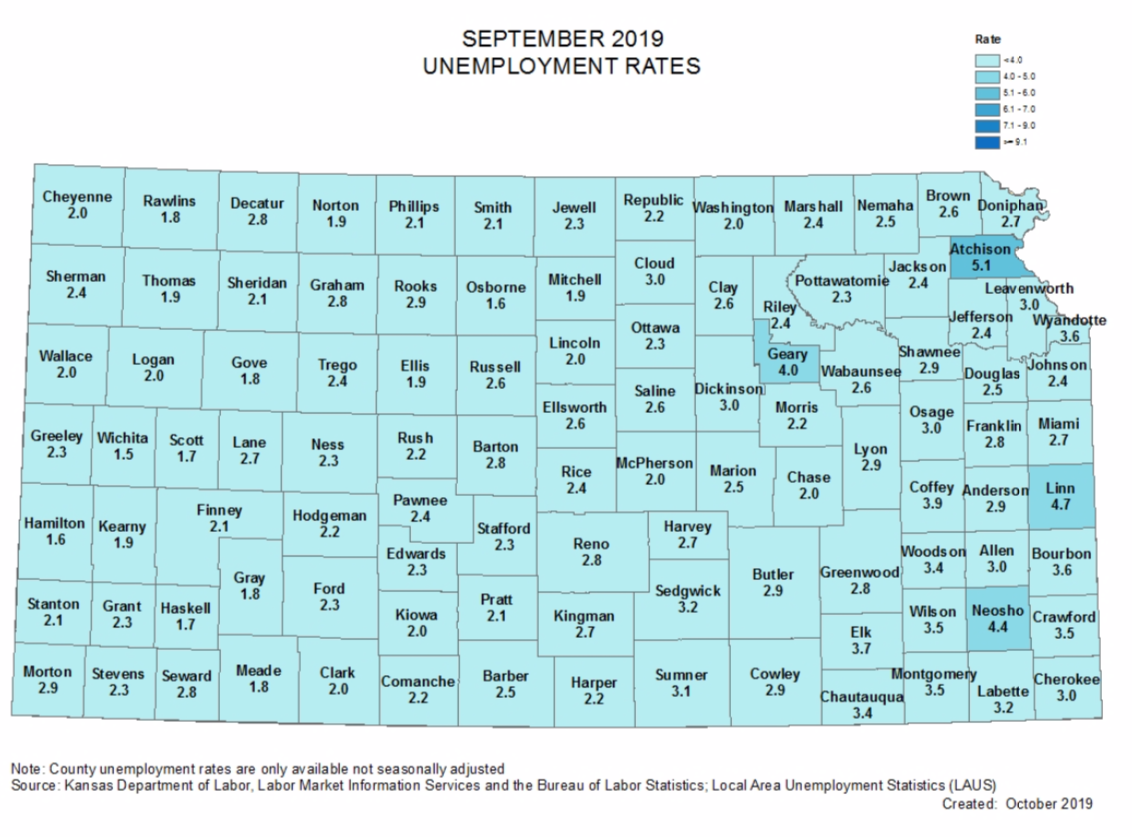
 Preliminary estimates reported by the Kansas Department of Labor and Bureau of Labor Statistics show a seasonally adjusted unemployment rate of 3.2 percent in September. This was unchanged from 3.2 percent in August and down from 3.3 percent in September 2018.